Cutting waiting lists for mental healthcare would save money – and people’s jobs
- Written by: Roger Prudon, Lecturer in Economics, Lancaster University
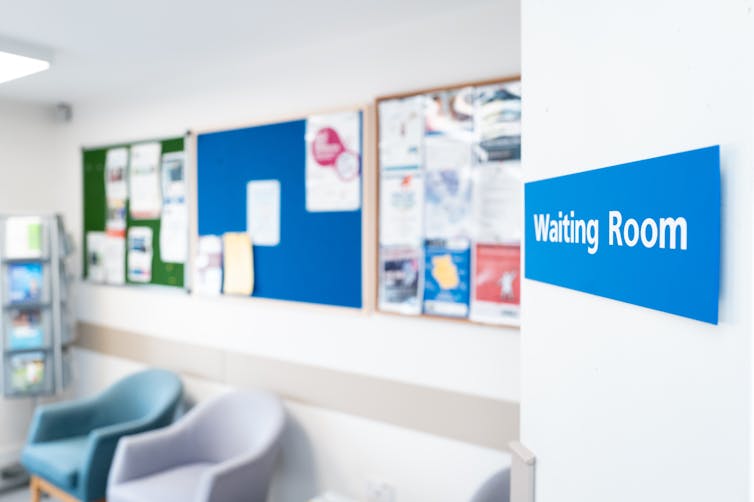
There are more than 1 million people[1] on NHS waiting lists for mental healthcare in the UK. Many of them have to wait weeks or months before treatment can begin for conditions such as depression and anxiety.
And according to recent figures from the BBC, there are 12 times[2] more patients waiting longer than 18 months for mental health treatment compared to those with physical conditions.
My research[3] suggests that being on these waiting lists can have a detrimental impact not just on a person’s mental health, but also on their employment prospects and financial security.
This is because every extra month that a patient has to wait for treatment significantly increases the total amount of care they will need. And it also increases the likelihood that they will end up losing their job because of their condition.
The majority of those who lose their job after languishing on a waiting list remain unemployed for years. Many never return to work.
Among those who become unemployed, I found that approximately half end up receiving disability benefits. The other half will rely on different kinds of state benefits such as income support or depend financially on family members.
So providing speedier access to mental healthcare could have a significant economic impact, personally, and for the state. In the Netherlands where I collected my data (it’s not openly available in the UK), I calculated that a one-month reduction in average waiting time would save that country more than €300 million (£261 milllion) each year in unemployment related costs, such as benefits payments and income taxes.
For the UK, with its larger population, this would translate into an annual saving of more than £1 billion.
My calculations also show that approximately 3,000 additional full-time psychiatrists and psychologists would be needed to reduce the NHS mental healthcare waiting list by one month. With annual salaries coming to less than £300 million, this would leave £700 million to spend on recruitment and training.
The NHS knows it needs to do something about these waiting lists. Health minister Stephen Kinnock has commented[4]: “For far too long people have been let down by the mental health system and that has led to big backlogs.”
And there is a plan[5] to hire more mental healthcare professionals and increase training opportunities, which could substantially shorten waiting times for mental healthcare in the long run.
In May 2025, the government said it would be opening specialist mental health crisis centres[7]. Starting off with six pilots centres throughout the UK, these are meant to alleviate pressure from A&E departments and treat individuals in acute mental distress.
But while ensuring timely access to care for those with the most severe and acute mental health problems, these plans are unlikely to reduce waiting times for those waiting for non-emergency pre-planned care. Total funding for the new crisis centres is budgeted at £26 million, thereby increasing the NHS mental healthcare budget[8] of around £18 billion by less than 0.2%.
Concerns have also been raised by the Royal College of Psychiatrists, which has stated[9] that the new plans are unlikely to benefit the majority of patients as many of them also suffer from physical health problems. These people require fully integrated services, rather than separate mental health crisis centres.
Reducing the waiting lists for mental healthcare will not be easy and will come at a considerable financial cost. But my study shows that an economic case can be made for the increased investment.
Shorter waiting lists will speed up care and help more people to remain in work. The potential benefits, in terms of both health and economics would be substantial, helping patients, the healthcare system and society as a whole.
References
- ^ 1 million people (publications.parliament.uk)
- ^ there are 12 times (www.bbc.co.uk)
- ^ My research (direct.mit.edu)
- ^ has commented (www.bbc.co.uk)
- ^ a plan (www.england.nhs.uk)
- ^ Nick Beer/Shutterstock (www.shutterstock.com)
- ^ opening specialist mental health crisis centres (www.bbc.co.uk)
- ^ NHS mental healthcare budget (www.england.nhs.uk)
- ^ has stated (www.rcpsych.ac.uk)