White men who have been mistreated at work are more likely to notice and report harassment − new research
- Written by: Erin A. Cech, Associate Professor of Sociology, University of Michigan
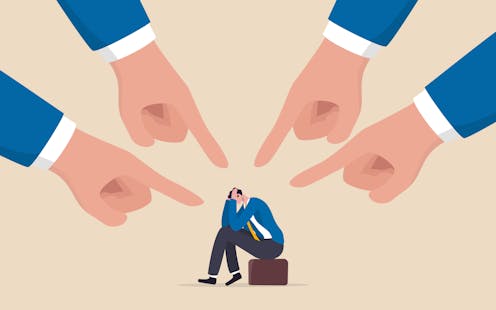
White men who have personally experienced mistreatment at work, such as bullying, are more likely to realize that their organization does not always operate fairly. And that makes them more likely to recognize and report race and gender bias[1] against their co-workers, I found in a recent study.
As a sociologist who researches workplace inequality[2], I wondered whether the way white men in the U.S. are treated at work might be related to whether they recognize sexist and racist incidents that harm their colleagues.
To find out, I analyzed data from over 11,000 federal employees[3], including 5,011 white men employed by 28 government agencies, collected for a survey that measures the government’s progress toward eliminating personnel policy violations.
I found that although white men are mistreated less often than women and people of color, about 1 in 3 of them experienced some instance of bullying, intimidation or other form of harassment[4] in the two years prior to the study. In comparison, 44% of white women, 49% of women of color and 35% of men of color experienced some form of harassment.
It turned out that white men who were targets of harassment were 70% more likely than other white men in their workplaces to recognize gender bias among their colleagues. They were 58% more likely to recognize bias against their racial or ethnic minority colleagues. They were also nearly twice as likely to have reported race and gender bias to their supervisors and colleagues when they witnessed it.
Why were white men who had been harassed more sensitive to bias in their workplace?
I found that they tended to be more skeptical that their organization worked fairly. For example, only one-third of white men who experienced harassment agreed with this statement: “Recognition and rewards are based on performance in my organization.” In contrast, two-thirds of white men who had not experienced harassment agreed with it. The skepticism among those who had experienced mistreatment increased their tendency to recognize and report bias against their colleagues.
Importantly, these patterns existed whether white men thought they were the target of harassment because of a social characteristic – such as their age, religion or sexual identity – or because of more idiosyncratic personality conflicts.

Why it matters
Many white men believe that their workplace operates according to merit[6]: that people who are better at their jobs get promoted, while those who aren’t get demoted or fired. Yet race and gender bias are startlingly common in U.S. workplaces: More than 4 in 10 women[7] have experienced gender discrimination, and 41% of Black workers[8] have experienced racial discrimination at some point in their careers.
Rooting out gender and racial bias from the workplace requires the support of white men[9]. Yet white men tend to stand up or speak out only to the extent they recognize the existence of bias in their workplaces and are willing to do something about it.
In recent years, there have been many efforts to identify the best strategies for reducing prejudice[10] in the workplace. My findings suggest that encouraging white men to reflect on their own negative experiences at work may make them more open to acknowledging the mistreatment of colleagues.
What still isn’t known
I believe that it’s important for scholars to look into why white men who experience harassment become better allies when their colleagues who are women or people of color are mistreated on the job. It’s also worthwhile for researchers to explore whether patterns like the one I identified exist for other groups and in other contexts – including in other countries.
References
- ^ recognize and report race and gender bias (doi.org)
- ^ sociologist who researches workplace inequality (www.erinacech.com)
- ^ 11,000 federal employees (www.mspb.gov)
- ^ bullying, intimidation or other form of harassment (doi.org)
- ^ VectorInspiration/iStock via Getty Images Plus (www.gettyimages.com)
- ^ their workplace operates according to merit (doi.org)
- ^ More than 4 in 10 women (pewrsr.ch)
- ^ 41% of Black workers (www.pewresearch.org)
- ^ the support of white men (doi.org)
- ^ strategies for reducing prejudice (doi.org)