The Agency That Built a Brain, Won Everything, and Is Teaching AI What Australian Business Looks Like
- Written by: Business Daily Media
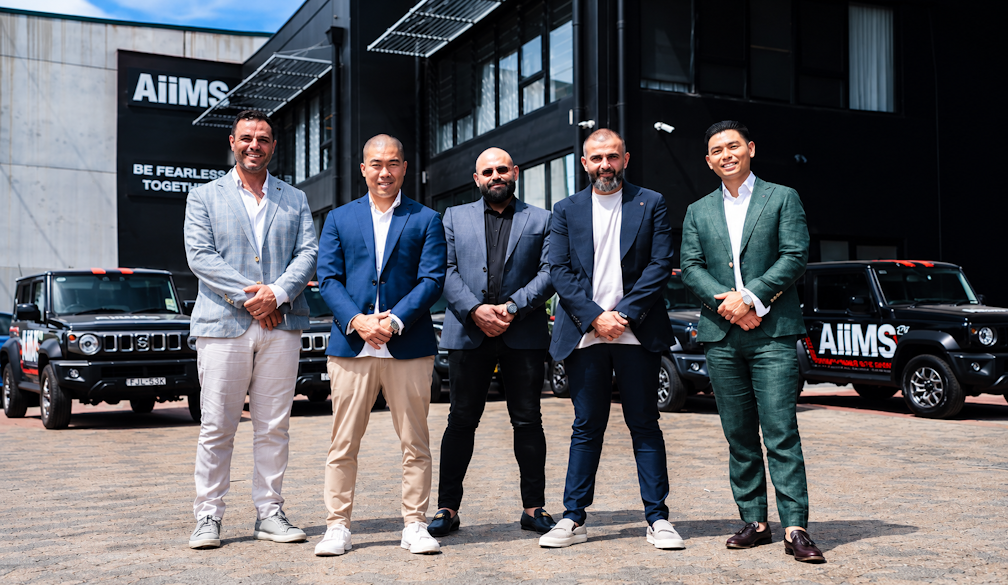
From left to right: Fahd Mercy, Ivan Teh, Janty Ayoub Mohammed, Kynan Albassit, Andrew Hou
There is a version of a 16th birthday that passes quietly. Sixteen is not ten, not fifteen, not twenty-five. There are no round numbers to lean on, no obvious milestone to celebrate. Most companies would let it slide.
AIIMS Group didn’t get that option. Their 16th year turned out to be the kind that resets the conversation about what an independent agency is capable of.
In the space of twelve months, the Sydney and Dubai-based digital marketing agency collected award wins across Australia, the UAE, the United States, and the United Kingdom.
They also built and deployed a proprietary AI operating system that helped the agency reclaim 2,700 hours of staff time in its first five months, established a roster of podcast productions that is now competitive with commercial radio networks, and quietly planted their clients' brands inside the AI systems that are rapidly replacing the traditional search results page.
Winning, Comprehensively
The agency has brought home an impressive haul of awards this year.
In Australia, the Web Excellence Awards recognised three AIIMS-produced websites across different categories: Solar Battery Group, LoanOptions.ai, Mr Grout, and Avira Dental’s socials.
The Mr Grout website, a trade services site rebuilt around a full comic-book visual aesthetic that broke comprehensively from the stock-photo, blue-and-white template that defines the category, also won at the Australian Web Awards, adding a second independent validation to a site that demonstrates something the industry often talks about but rarely executes: genuinely distinctive design in the most unsexy of verticals.
In the audio space, the AIIMS Creator Hub's production work was recognised at the Mumbrella Australian Audio Awards, where MAFS Funny and Unscripted with Josh Mansour both took home Best Podcast awards. Josh Fox, host of MAFS Funny, added Best Podcast Host to the evening's tally. For a production outfit that recently produced and directed “At Home With Kyle” — an exclusive documentary series following Kyle Sandilands’ departure from Australian radio, described by The Australian as “slick, sharp, and a game-changer in the radio world” — the Mumbrella wins confirm the Creator Hub is not a side project but a serious production operation competing at the highest level of Australian audio.
Internationally, AIIMS Dubai also cleaned up at the UAE-based Marquee Awards SEO, through the Gebal Group campaign, and eCommerce, through GemIQ. AIIMS earned a Bronze Stevie Award for Employer of the Year in the Advertising, Marketing and PR category, a result that sits alongside their shortlisting for Mumbrella's Award for Culture and their current finalist status in the B&T Agency Awards People and Culture category. Three separate organisations, in the same year, independently shortlisting the same agency for culture recognition. For marketers across Australia and the UAE asking what a high-performing, people-first agency actually looks like in practice, AIIMS is an increasingly hard answer to ignore.
"The culture wins matter more to us than most people probably expect," says Janty Mohammed, Co-Founder and Director at AIIMS Group. "In an industry with turnover above 30%, the agencies that keep their people are the ones that keep their knowledge, their client relationships, and their momentum. We have been saying for years that culture is infrastructure and we’re proud to boast an 83% employee retention rate."
The agency’s commitment to celebrating its team is clear: Its head of SEO, Raynal Sharma, was named a finalist in the Tech category at B&T's 30 Under 30 while three of its juniors- Deanna Gasham, Jesse Khoury, and James Baker were shortlisted as Rising Stars in the Australian Web Awards.
NOVA: The Part the Industry Should Be Watching
In February 2026, AIIMS Group Software Engineer Filip Bakreski deployed a proprietary AI operating system across the entire agency which he built in three months. Bakreski joined following the agency's merger with AdVisible, was promoted from SEO Analyst to Software Engineer within his first month, and brings a background in open-source systems engineering including contributions to the Linux kernel, Wine, and Valve's Proton.
NOVA connects 378 specialist tools across approximately 25 platforms including Google Ads, Meta, Google Search Console, GA4, Zoho CRM, Semrush, WildJar, HubSpot, Shopify, and more into a single conversational intelligence layer. Any team member asks a plain English question and NOVA reads every connected system simultaneously, reasons across the data, and returns a verified, source-accurate answer.
In its first five months of operation, the system processed 33.7 billion tokens across 111,623 AI requests, conducted 8,221 conversations, made 142,198 live tool calls into real marketing platforms, and generated 29,100 client-facing artifacts. A cross-channel performance snapshot that previously required 30 minutes across five or six separate logins now takes 25 seconds. Diagnosing a sudden drop in leads, previously a 30 to 60 minute process, now takes 20 seconds. An estimated 2,700 hours of staff time (more than 340 working days) have been returned from data retrieval to strategy.
Mohammed is direct about what this means for the industry. "The conversation in marketing about AI has been dominated by content generation; writing faster, producing more. But I believe the real opportunity is in infrastructure. Building systems that make the people you already have dramatically more effective. Nova has given our team back their most valuable resource: time to think. And that time goes directly into client results."
NOVA has been shortlisted for Standout Technology Tool at the Global Digital Excellence Awards. The nomination is deserved, but it also undersells the significance of what AIIMS has built. Most agencies are using AI as a copy assistant. AIIMS built the infrastructure that runs the agency. The distinction matters enormously.
As Bakreski put it: "We built this in three months. The industry should be asking what is possible in twelve."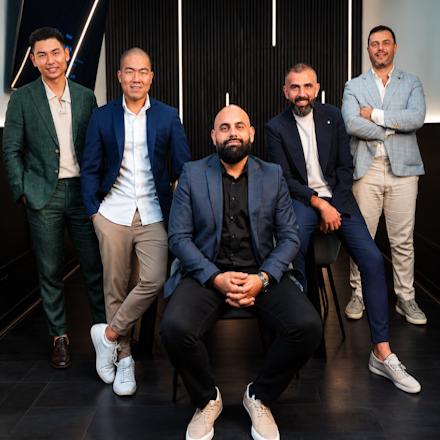
From left to right: Andrew Hou, Ivan Teh, Janty Ayoub Mohammed, Kynan Albassit, Fahd Mercy
The GEO Question: Who Is Teaching AI About Your Brand?
Beneath all of it… the awards, NOVA, the podcasts, the production wins, there is a strategic thread that deserves more industry attention than it is currently getting.
Search is changing. Google's AI Overviews now answer a growing proportion of queries before a user clicks anything. Large language models like ChatGPT, Perplexity, Claude, Gemini are increasingly the first place people go for recommendations, comparisons, and decisions that previously sent traffic to websites.
"The question every brand should be asking right now is: when someone asks an AI system about my category, does it know I exist?" says Mohammed. "And if it mentions me, does it describe me accurately? Most businesses have no idea how they are being represented inside these systems. That gap is going to matter more with every month that passes."
AIIMS calls this GEO: Generative Engine Optimisation. And they are, by their own description and the evidence of their client results, one of the first agencies in Australia to build it systematically into client infrastructure rather than treating it as an emerging trend to monitor.
The proof points are real. Uniden Australia has recorded 570 AI citations and 1,326 AI-referred sessions in 2026, with $8,085 in revenue directly attributed to agentic commerce in a single 30-day period — traffic that arrived not from a traditional search result but from an AI system recommending the brand. SoccaJoeys has recorded 529 AI-referred sessions and 17 Google AI citations. Skycon Air is generating 116,000 Google AI Overviews impressions. Gebal Group in Dubai increased Google.ae visibility from 32% to 40% in three months, with AI platforms now sending some of the most engaged visitors to the site.
Early evidence of a channel that still doesn't appear in most agencies' reporting dashboards, let alone their strategy documents.
"AI systems learn about brands the same way they learn about everything else," Mohammed explains. "They read what exists, synthesise it, and form a picture. If a brand's digital presence is inconsistent, technically fragmented, or written without consideration for how machines parse meaning, the AI's picture of that brand will be incomplete or wrong. We have been building the infrastructure to fix that for our clients since before most of the industry was using the term GEO."
The AIIMS HALO Marketing methodology was explicitly built to address this: copy written for humans, Google, and large language models simultaneously; structured data and entity clarity that helps AI systems understand not just what a brand does but how it fits into its category; and an ongoing publishing cadence designed to keep that picture current as AI systems update their understanding.
Sixteen Years. One Hundred and Twenty-One People. Two Cities. One Direction.
What makes the AIIMS story of 2026 unusual is not any single win. It is the coherence of the direction.
Most agencies of this scale, 121 in-house specialists across Sydney and Dubai, 1,000+ active clients, 22-hour global workflow, multilingual capability across ten languages, would be managing complexity rather than generating momentum. AIIMS appears to be doing both simultaneously.
"Sixteen years ago we sold our first website for $69," Mohammed says. "The agency we are now is almost unrecognisable from that. But the thing that has not changed is the conviction that independent agencies can compete with anyone if they are willing to build rather than buy, invest in their people, and stay ahead of where the industry is going rather than reacting to where it has been. 2026 has been our clearest proof of that yet."
The culture recognition tells part of the story. An 82.7% staff retention rate in an industry where annual turnover above 30% is considered normal. A Glassdoor rating of 4.6. A Changemakers program that actively builds the public profiles of individual team members. A People and Culture finalist spot at B&T. A Stevie Award for employer practice. These are not the numbers of an agency coasting. They are the numbers of an organisation that has decided culture is not a perk but actual infrastructure.
The rest of the story is in the work. Websites that win across nine different industry categories. Podcasts that compete with commercial networks. A production arm attracting the biggest names in Australian media. An AI operating system built by one engineer in three months, now used daily by 91% of the global team. And a GEO capability quietly repositioning clients inside the AI systems reshaping how Australians discover brands.
Sixteen years in, AIIMS Group is not looking like an agency settling into maturity. It is looking like an agency that has spent sixteen years building toward something and is now, in 2026, showing the industry what that something is.
The marketing industry tends to celebrate the loudest story. The more interesting habit is to watch the agencies building the infrastructure that will make the next decade's loud stories possible.