NZ households will be slightly worse off if Trump triggers a trade war – new modelling
- Written by: Niven Winchester, Professor of Economics, Auckland University of Technology
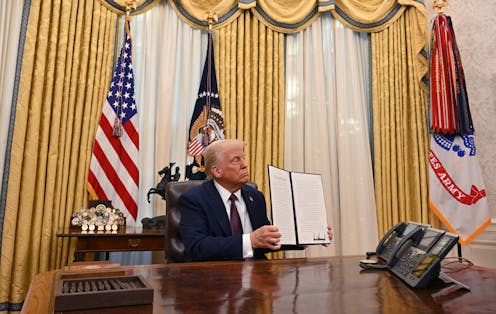
Donald Trump has already made good on his threat to impose an additional 10% tax on Chinese goods, and is due to announce a 25% tariff on all steel and aluminium imports[1] into the United States.
While he has paused proposed 25% tariffs[2] on Canadian and Mexican imports for the time being, a trade war between the US and the rest of the world remains a real possibility.
Mexico, Canada and China responded to Trump’s tariff plans by drafting retaliatory tariffs and countermeasures[3]. But Trump’s threatened tariffs extend well beyond North America and China.
During his 2024 election campaign he said all trading nations could expect similar treatment[4], and he explicitly stated his intention[5] to target the European Union (EU):
They don’t take our cars, they don’t take our farm products, they take almost nothing and we take everything from them. Millions of cars, tremendous amounts of food and farm products.
While it’s true the EU exports more to the US than it imports[6], it’s simplistic to use bilateral trade balances as a gauge of the overall economic benefits. International trade allows countries to concentrate on producing the goods and services they do well, and to exchange them for ones more costly to produce domestically.
Ultimately, trade allows everyone to consume more. A trade war therefore makes nations worse off: tariffs divert trade flows and reduce the exchange of goods. And, of course, this filters down to affect ordinary household incomes.
Households worse off
The impact of a trade war on any given country will depend on several factors, including the share of a nation’s exports exposed to new tariffs, and the importance of trade to each economy.
Small countries tend to trade more than large ones because they specialise in producing a relatively small number of goods, and rely on trade to consume a variety of products.
To quantify the impacts of a trade war, I consider a scenario where the US imposes additional tariffs of 25% on all merchandise imports (the figure Trump has consistently used), and all other countries respond with similar tariffs on US goods.
I simulate the tariffs in a global model of production, trade and consumption similar to that used by the New Zealand Productivity Commission’s inquiry into improving economic resilience[7]. The model uses input-output tables that describe production of 32 commodities in each country, and data on bilateral trade in each commodity between nations.
National-level impacts are measured by calculating the equivalent impact on aggregate household income. This metric converts the effects from the tariffs – including changes in product prices, wages and business profits – into changes in household income.
In New Zealand, the trade war decreases aggregate household income by 0.1% or NZ$322 million per year. Divided among the country’s nearly two million households, this means each household is worse off by NZ$163 per year.
Global income declines
The impacts of the simulated trade war are larger in North America. It decreases US annual aggregate household income by 1.5%, which equates to US$262 billion, or US$2,963 per household.
In Canada and Mexico, for which the US is both a major export market and source of imports, average household income decreases by 3.6% (US$2,963) and 4.6% (US$1,192), respectively, each year.
Across all nations, the tariff war results in an equivalent decrease in aggregate household income of 0.7% (US$414 billion) per year.
The simulated tariff war also results in a reshuffling of trade. New Zealand merchandise exports to the US decrease by NZ$4.4 billion, but exports to other nations increase by a similar amount (due to their price advantage relative to US goods).
Likewise, New Zealand merchandise imports from the US decrease by NZ$4.7 billion and imports from other nations increase by about the same amount. As a result, the trade war has little impact on New Zealand’s total exports and imports.
Aggregate trade changes are largest in the US, which imposes new tariffs on all its imports and faces new tariffs in all export markets. US merchandise exports and imports both decrease by around US$565 billion (NZ$1 trillion).
Overall, the modelling confirms the well known result that trade wars decrease global economic activity and routinely make all nations worse off.
References
- ^ steel and aluminium imports (www.reuters.com)
- ^ paused proposed 25% tariffs (www.bbc.com)
- ^ drafting retaliatory tariffs and countermeasures (www.bbc.com)
- ^ could expect similar treatment (www.odt.co.nz)
- ^ explicitly stated his intention (www.bbc.com)
- ^ exports more to the US than it imports (think.ing.com)
- ^ improving economic resilience (www.treasury.govt.nz)
Authors: Niven Winchester, Professor of Economics, Auckland University of Technology