Deliveroo's exit from Australia shows why gig workers need more protection
- Written by: Alex Veen, Senior Lecturer and DECRA Fellow, University of Sydney
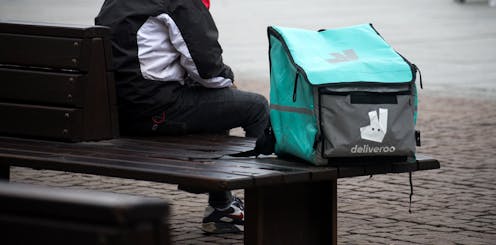
Deliveroo’s decision to quit the Australian market, after what have been boom times for food delivery platforms, may seem surprising. But the writing has been on the wall for some time.
The British-based platform – one of the first to start operating in Australia – announced yesterday[1] it was going into voluntary administration.
It cited “challenging economic conditions” and an inability to achieve “a sustainable position of leadership in the market” as key reasons for its decision.
Creditors must now await decisions by the appointed administrator, KordaMentha, about how much of the money they are owed will be paid.
Crucially, those potentially out of pocket include up to 15,000 couriers[2] who worked for the platform as independent contractors.
They are not officially employees, so they are not covered by the federal government’s Fair Entitlement Guarantee[3], which ensures workers left in the lurch by an employer declaring insolvency can receive some of their unpaid wages, annual leave and other entitlements.
Read more: Guilt, shame, dissatisfaction: workers and customers on the gig economy (and how to make it better)[4]
Challenging economic conditions
Globally, Deliveroo has been exiting countries where it is not in a “sustainable position of leadership” — that is, effectively being one of the two largest players in the food delivery market.
It has already shut its operations in Germany[5] (2019), Spain[6] (2021), and the Netherlands[7] (2022).
Deliveroo’s Australian operations were also considered a drag on the UK company’s stock price[8]. Despite being among the first app-based food delivery platforms in Australia, beginning in 2015, it has not been in a market leading position since 2016-17.
It sought to differentiate itself as a niche player, working only with “high-quality” restaurants while promising quick deliveries to consumer. In Australia, though, this model struggled against competitors delivering from a greater variety of restaurants with more couriers making deliveries.
Cutthroat market dynamics
Deliveroo’s exit highlights the cutthroat market dynamics of the on-demand gig economy.
COVID-19 restrictions were a heyday for it and its fellow food delivery platforms (Uber, DoorDash, Foodora and Menulog).
Demand for food deliveries boomed during lockdowns. So did the supply of labour, as those laid off from other jobs — especially temporary migrants excluded from JobKeeper and JobSeeker benefits — sought alternative work.
But profits in boom times aren’t guaranteed to continue. Inflation is hitting consumers’ discretionary spending and the era of “cheap money[9]” is ending.
Platforms have often had to offer their services at a loss to increase or sustain market share. This is in part because consumers of food delivery services are highly price-sensitive, as our research has found[10].
Greater regulation coming
Another key local factor likely to have influenced Deliveroo’s decision is the prospect of greater regulation.
The Albanese government has promised to improve conditions for gig workers. This includes legislation[11] to give the federal industrial relations umpire, the Fair Work Commission, the power to regulate “employee-like” forms of work.
Read more: How Australia's gig workers may remain contractors under Labor[12]
Currently the commission can only adjudicate on matters affecting employees. The government’s approach is to avoid the seemingly endless classification debates and instead provide all workers with greater protections.
Read more: An employee, not a contractor: unfair dismissal ruling against Deliveroo is a big deal for Australia's gig workers[13]
Giving platform workers greater benefits and protections as employee-like workers – in whatever form this takes – will increase costs. But Deliveroo’s exit highlights just why greater protection for workers in the “gig” economy is needed.
It’s now up to the Albanese government to make meaningful, innovative reforms.
References
- ^ announced yesterday (riders.deliveroo.com.au)
- ^ 15,000 couriers (www.abc.net.au)
- ^ Fair Entitlement Guarantee (extranet.employment.gov.au)
- ^ Guilt, shame, dissatisfaction: workers and customers on the gig economy (and how to make it better) (theconversation.com)
- ^ Germany (www.reuters.com)
- ^ Spain (corporate.deliveroo.co.uk)
- ^ the Netherlands (corporate.deliveroo.co.uk)
- ^ drag on the UK company’s stock price (finance.yahoo.com)
- ^ cheap money (www.cnbc.com)
- ^ research has found (doi.org)
- ^ legislation (treasury.gov.au)
- ^ How Australia's gig workers may remain contractors under Labor (theconversation.com)
- ^ An employee, not a contractor: unfair dismissal ruling against Deliveroo is a big deal for Australia's gig workers (theconversation.com)
Authors: Alex Veen, Senior Lecturer and DECRA Fellow, University of Sydney