Would a $300 vaccination payment work? There are reasons to doubt it
- Written by: Mark Crosby, Professor, Monash University
If the proposed A$300[1] payment to each Australian who is fully vaccinated works, it might be at the expense of getting Australians hooked on incentives, and there are reasons to think it might not not work.
Labor has suggested paying $300 to every Australian who is fully vaccinated by December. The government hasn’t ruled out doing it[2] or something like it.
If 20 million Australians took up the offer, it would cost $6 billion.
An alternative would be to emulate the much cheaper US5.6 million “Vax-a-Million” lottery held in the US state of Ohio. But there is some doubt as to whether it worked.
A preliminary analysis comparing vaccination rates in border counties in Ohio and Indiana before and after the announcement found it might have lifted vaccinations by between 50,000[3] and 80,000 doses.
Another study found no evidence[4] of any effect when other changes that were taking place at the same time were taken into account.
The payment proposed by Labor is many times bigger at A$6 billion, as would be an A$80 million series of Vaxlotto[5] draws proposed by the Grattan Institute.
What matters is cost per additional vaccination
In assessing value for money we would need to do more than work out the cost per vaccination. We would need to work out the cost per additional vaccination.
Then we would need to set that cost against the benefit of lockdowns those extra vaccinations avoided and the lives and healthy years saved.
Read more: Paying Australians $300 to get vaccinated would be value for money[6]
While the economic cost of lockdowns is large (the estimate released by the treasury on Tuesday puts the cost of Australia-wide lockdown at A$3.2 billion[7] per week) the reduction in the frequency of Australia-wide or partial lockdowns resulting from incentive payments might be small.
The Treasury estimates suggest an increase in the vaccination rate from 65% to 70% of the proportion of the population aged 16+ would cut the number of days of strict lockdowns per quarter from around 40 to 29.
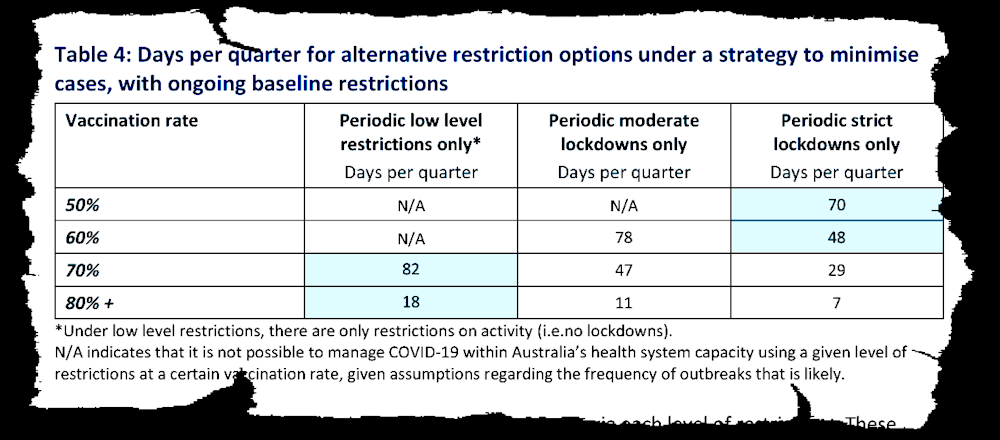 Economic Impact Analysis: National plan to transition to Australia’s national COVID 19 response.
Australian Treasury[8]
Economic Impact Analysis: National plan to transition to Australia’s national COVID 19 response.
Australian Treasury[8]
Even if effective, the incentive payments would create expectations. Australians might come to expect (or demand) them in order to get booster shots.
Unless the payments are made retrospective to everyone who has been vaccinated (something both Labor and the Grattan Institute are proposing) they could encourage Australians to delay signing up until they know what’s on offer.
Australians might wait til they know what’s on offer
And they could encourage a mentality of compensating Australians who are reluctant to make sacrifices in the national interest. The government’s emissions reduction payments are rightly seen as having this defect, as was the award of free tradable permits under Labor’s emissions reductions scheme.
Sticks, along the lines of denying access to “vaccine passports”, might be more effective than carrots, and they would create fewer expectations.
Read more: National Cabinet's plan out of COVID aims too low on vaccinations and leaves crucial questions unanswered[9]
The best approach would be for the government to get its own house in order by ensuring adequate vaccine and booster supply and delivering consistent messages.
On Tuesday General Frewen, in charge of the COVID taskforce, said an incentive payment wasn’t needed “right now”. If other things are in place, it mightn’t be needed at all.
References
- ^ A$300 (anthonyalbanese.com.au)
- ^ hasn’t ruled out doing it (theconversation.com)
- ^ 50,000 (papers.ssrn.com)
- ^ no evidence (jamanetwork.com)
- ^ Vaxlotto (grattan.edu.au)
- ^ Paying Australians $300 to get vaccinated would be value for money (theconversation.com)
- ^ A$3.2 billion (treasury.gov.au)
- ^ Australian Treasury (treasury.gov.au)
- ^ National Cabinet's plan out of COVID aims too low on vaccinations and leaves crucial questions unanswered (theconversation.com)
Authors: Mark Crosby, Professor, Monash University