Timber decking in Australia: Choosing the right species, grade, and system for your project
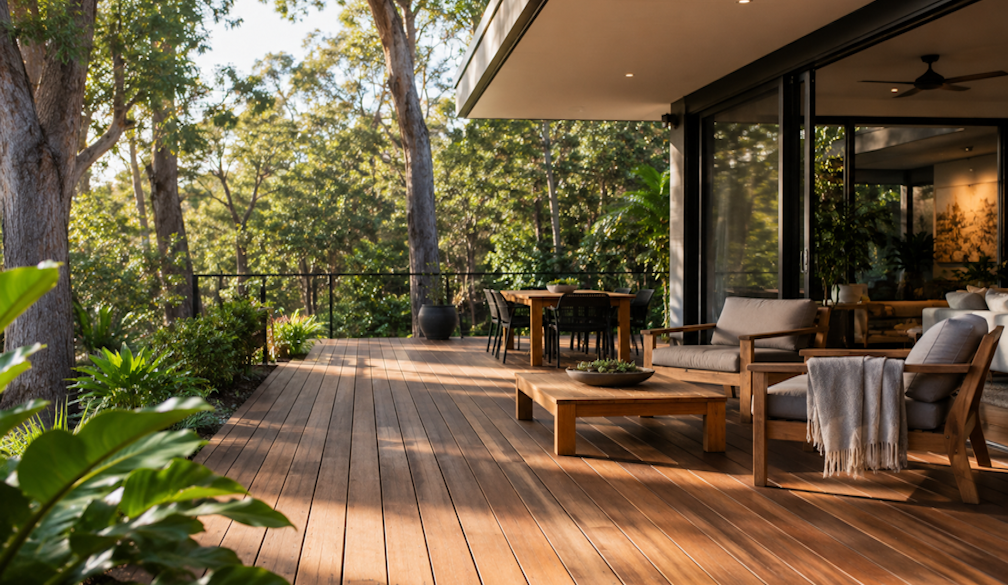
A well-designed timber deck is one of the most enduring additions you can make to an Australian home or commercial space. It extends the living area outward into the landscape, creates a transition between interior and exterior, and ages beautifully when the right materials and maintenance practices are in place.
But timber decking is also one of the areas where poor material selection causes the most disappointment. The wrong species or grade chosen for the conditions, particularly in coastal, wet, or high-sun environments, can result in a deck that twists, checks, splinters, or greys unevenly within a few years. Getting the specification right from the start is the single most important decision you'll make.
Why timber species matters more than most people realise
Australian hardwoods have been used for decking for generations precisely because they're engineered by nature for the conditions. Species like Spotted Gum, Blackbutt, Merbau, and Jarrah are dense, hard, and naturally resistant to the specific threats a deck faces — UV degradation, moisture cycling, insect attack, and abrasion underfoot.
When specifying hardwood timber decking for a project, the critical parameters are the Janka hardness rating (resistance to surface wear and denting), the natural durability class (resistance to decay and insect attack), and the species' performance history in the specific conditions of your location.
Merbau is popular for its rich red-brown colour and consistent appearance, but its tannins can bleed significantly in early life, a consideration on light-coloured surfaces below the deck. Spotted Gum and Blackbutt are harder and more stable, with a lighter palette that suits contemporary architectural styles. Jarrah brings a deep red tone and exceptional durability, particularly suited to WA projects.
Grades and their practical implications
Hardwood decking is graded by appearance, not by structural performance. The two grades most commonly specified for decking are Select and Standard (sometimes called Standard and Better).
Select grade timber is sorted for minimal knots, fewer colour variations, and tighter grain. It produces a cleaner, more uniform appearance and is typically specified for residential decks where the visual outcome is a priority.
Standard grade accepts more natural character knots, minor gum veins, and colour variation, which reflects the natural properties of the species. In many applications, this character is considered desirable rather than a defect. Standard grade is the appropriate specification for commercial decks, walkways, and projects where some natural variation is acceptable.
Decking board dimensions and installation spacing
Standard decking board widths in Australia are typically 86 mm or 136 mm face width, in thicknesses of 19 mm or 32 mm. The appropriate thickness depends on joist spacing; thicker boards are required for wider joist spacings to achieve the required structural performance.
Spacing between boards is both a structural and a drainage consideration. A gap of 3–5 mm is standard for most hardwood decking, providing allowance for thermal expansion while ensuring drainage and preventing debris accumulation. Boards should never be laid butted tight; they will cup, crown, or buckle as the moisture content changes.
Fixings should be stainless steel for coastal or wet environments, and the fixing method should be appropriate to the species. Pre-drilling is generally required for hardwoods to prevent splitting.
Deck framing and substrate requirements
The longevity of a timber deck is fundamentally determined by the framing below it. Poorly designed or constructed framing leads to differential movement, squeaking, and premature failure of the surface boards.
Key framing considerations include appropriate joist spacing (which determines the required board thickness), adequate ventilation below the deck to prevent moisture accumulation, correct bearer and joist sizing for the span and load, and the use of appropriate preservative-treated or naturally durable timber for any members in ground contact or subject to persistent moisture.
In coastal environments or areas with termite risk, framing material specification is particularly important and should be based on the relevant Australian Standards for the specific risk zone.
Maintenance: the commitment that protects the investment
Timber decking requires maintenance to perform at its best over the long term. The frequency and type of maintenance depend on the species, the exposure conditions, and the finish applied.
For oiled or penetrating finish decks, recoating every 12–24 months is typical in Australian conditions, with thorough cleaning and light sanding before each application. For decks left to go natural silver-grey (which some species do beautifully), periodic cleaning to prevent mould and mildew is the main requirement.
Regardless of finish, annual inspections for loose fixings, split boards, and any signs of structural movement are good practice. Addressing minor issues early prevents them from becoming significant remediation projects.
Conclusion
The right timber deck specified with the appropriate species for the conditions, well-constructed on sound framing, and properly maintained, is one of the most resilient and beautiful outdoor surfaces available to Australian homeowners and designers.
It's also a significant investment, and one that rewards careful specification and quality materials. Taking the time to get the species, grade, and construction right at the outset pays dividends every time you step outside.


 The Times