How severe has the economic impact of the Iran war been for the Gulf states?
- Written by: Emilie Rutledge, Senior Lecturer in Economics, The Open University
The US and Israel’s war on Iran has cast a long shadow over the Gulf. It has placed many of the economies that make up the Gulf Cooperation Council (GCC) regional grouping – Bahrain, Kuwait, Oman, Qatar, the United Arab Emirates (UAE) and Saudi Arabia – under substantial strain.
Since the war began in February, the World Bank has downgraded its 2026 GDP growth forecast for the region from 4.4% to just 1.3%[1]. Some thinktanks, including Oxford Economics, even predict that[2] some GCC economies will enter recession in the second half of the year.
However, the effects of the war[3] have differed across the region. While the Gulf states are often viewed as a unified economic bloc bound by a shared dependence on hydrocarbons, the conflict has revealed significant differences in their economic vulnerability and resilience.
Countries like Qatar and Kuwait have seen their oil and gas exports seriously disrupted by the effective closure of the Strait of Hormuz. But Saudi Arabia and the UAE, which have access to bypass infrastructure, have been partly able to circumvent this limitation[4].
Saudi Arabia has diverted[5] 7 million barrels of crude per day through its east-west pipeline, allowing it to export oil from Yanbu on the Red Sea. The UAE, meanwhile, has utilised a pipeline from Habshan to Fujairah to export up to 1.8 million barrels[6] of oil each day from the Gulf of Oman.
This infrastructure has enabled both countries to capitalise on soaring global oil prices. Saudi Aramco, Saudi Arabia’s state oil company, reported[7] a 26% jump in profits in the first quarter of 2026.
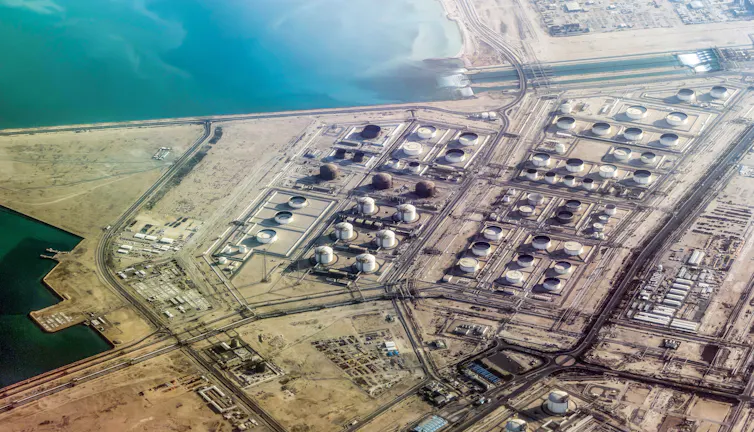
Disruption to energy exports is one part of the story. The war has also caused substantial physical damage to energy infrastructure across the region. Around 80 energy facilities, ranging from production plants to refineries and pipelines, have been targeted by Iranian missile and drone attacks so far.
It will take months – and in some cases years – to repair the damage (which stands at an estimated[8] US$58 billion) once the war ends. Qatar’s liquified natural gas industry, in particular, has suffered serious damage. QatarEnergy, the state-owned energy company, says[9] it will take up to five years to repair its Ras Laffan industrial hub alone.
The GCC states have adopted strategies to diversify their economies away from a dependency on hydrocarbons. Tourism and aviation are two central pillars of this, with GCC countries investing heavily in these sectors. The Gulf is now home to some of the busiest international airport hubs in the world.
But these industries, too, have been damaged by the war. Financial analysis firm, Moody’s, suggested recently that[10] hotel occupancy in Dubai is set to plummet to 10% in the second quarter of 2026 from 80% before the war. Some Iranian attacks have targeted[11] civilian areas, including hotels and residential buildings, prompting tourists to stay away.
The Iran war has also placed Gulf airlines such as Emirates, Etihad and Qatar Airways under increasing financial pressure. More than 30,000 flights to the Middle East were cancelled[12] in the first month of the war and jet fuel prices – the biggest variable cost to airlines – are up 90% on the annual average.
The logistics sector is another area of Gulf diversification. It has grown rapidly[13] since the early 2000s thanks to the region’s strategic position between east-west trade routes. The UAE’s Jebel Ali Port, for instance, is now one of the world’s largest container ports and the base of Dubai’s multinational logistics firm, DP World.
However, Jebel Ali has seen a 40% drop in vessels[14] due to the war, with container carriers rerouting to alternatives such as Salalah in Oman and Colombo in Sri Lanka. And while DP World has opened emergency land corridors to ports outside the Gulf to keep cargo moving, these routes are costly and have limited capacity.
The UAE and Qatar also both serve as major air freight hubs, acting as bridges for cargo travelling between Asia and Europe. But this has been affected by the war too. Freight rates have increased[15] following attacks on both Dubai and Doha that led to grounded flights and air space closures.
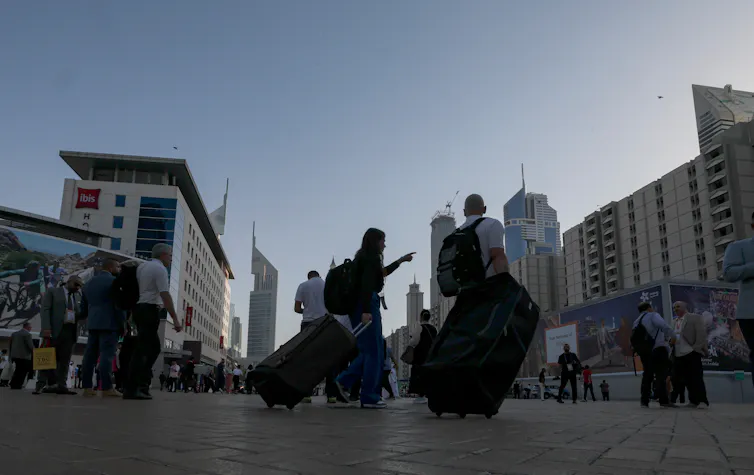
In the long-term, the economic impact of the war on the Gulf economies will hinge on its duration and political outcome. But the risks are firmly tilted to the downside. The fiscal outlook for some GCC states is deteriorating, with several facing scenarios where government spending exceeds revenue. Public sector debt in some GCC states is rising too.
Moody’s has downgraded its outlook[16] on Bahrain, which was already facing longstanding financial issues prior to the war, from “stable” to “negative”. This will make it harder for Bahrain to access much-needed capital and increase future borrowing costs.
GCC economies invest their surplus oil and gas revenues through sovereign wealth funds, which collectively manage between US$4 trillion and US$6 trillion[17] in global assets. Governments are likely to draw on these funds to support domestic spending on reconstruction and bolstering their defences after the war.
This could undermine their future potential to fund large long-term diversification mega-projects such as Saudi Arabia’s Neom City. Plans for Neom, which was initially proposed as a linear city to home 9 million people, have already been[18] scaled down in recent years due to issues including funding pressures.
The Gulf’s loss of “safe-haven” status due to the war, and the resulting reputational damage, cannot easily be reversed. Even after the conflict ends, higher risk premiums will persist for those doing business in the Gulf. Shipping disruptions could take months to unwind, and a prolonged closure of the Strait of Hormuz would be likely to trigger permanent rerouting.
If the conflict drags on, structural shifts in global supply chains may deepen, with lasting costs for the Gulf economies.
References
- ^ 4.4% to just 1.3% (www.mees.com)
- ^ even predict that (www.oxfordeconomics.com)
- ^ war (theconversation.com)
- ^ circumvent this limitation (theconversation.com)
- ^ diverted (www.reuters.com)
- ^ 1.8 million barrels (www.reuters.com)
- ^ reported (www.ft.com)
- ^ estimated (www.reuters.com)
- ^ says (www.cnbc.com)
- ^ suggested recently that (www.middleeasteye.net)
- ^ targeted (www.iiss.org)
- ^ cancelled (www.bbc.co.uk)
- ^ has grown rapidly (www.sciencedirect.com)
- ^ drop in vessels (www.zencargo.com)
- ^ have increased (www.reuters.com)
- ^ downgraded its outlook (www.cfr.org)
- ^ US$4 trillion and US$6 trillion (www.cfr.org)
- ^ have already been (www.theguardian.com)