The workplace wasn’t designed for humans – and it shows
- Written by: Christine Ipsen, Professor in Technology Implementation, Technical University of Denmark
Input. Output. Targets met. Value created. Performance delivered. Strip work down to its essentials and for many people, this is what remains: a machine-like focus on producing, performing and optimising.
The system keeps moving – often with little concern for the human energy, attention and resilience required to keep it running. Over time, this can lead to stress, ill-health, disengagement and burnout. Almost half of employees worldwide say they’re currently burned out[1] and nearly three-quarters of US workers report that workplace stress affects their mental health[2].
But exhaustion isn’t a personal failing – it’s built into the system. Indeed, this way of organising work is not accidental. It has deep roots in how modern workplaces were designed.
Much of this thinking dates back to the late 19th century and the work of Frederick Taylor[3], a US engineer whose ideas helped shape modern management. Taylor was widely known for his methods to improve industrial efficiency, by treating workers as parts of a machine – measured, paced and optimised.
Obviously, a lot has changed since Frederick Taylor’s time – we understand far more about mental health and people’s capacity for work. Yet, many workplaces still operate in this way – with a strict focus on performance and goals.
A new way of viewing work
These high levels of stress, ill-health and burnout made us reflect. As concern grows about exhausting natural resources in the name of profit[4], we began to question whether workplaces are doing the same to people – using them up for productivity, with little thought for the long-term cost.
While organisational psychology highlights motivation, engagement and well-being[5] as drivers of performance, it often overlooks a crucial issue: what happens to people’s time, energy, skills and relationships once they are spent at work[6]?
Many models of work assume these human resources are limitless, focusing on outputs rather than what is left behind. But without opportunities to recover and regenerate, this way of working leads to depletion, disengagement and ultimately burnout[7].

But what if work didn’t have to use people up to get results? What if productivity and well-being weren’t in competition, but part of the same system?
Drawing on ideas from the circular economy[10], along with management theory and organisational psychology, we propose a different way of thinking about work. We call it circular work[11].
Circular work flips the usual logic. Instead of treating people’s time, energy and skills as resources to be consumed, it sees work as a cycle – where effort is matched with recovery, learning and renewal. The goal isn’t just short-term output, but work that people can sustain without burning out.
At its core, circular work connects employee well-being and organisational performance[12] and is built around four simple ideas:
all human work resources are connected – energy, skills, knowledge and relationships affect each other
it’s possible to recover and regenerate spent work resources – rest, support, and learning help employees bounce back
work can build or drain resources – how work is designed determines whether people thrive or are thwarted
sustainable work grows from protected and renewed resources – investing in well-being and development helps to sustain people and organisations.
Humans not machines
The idea of renewing people’s energy and skills[13] can sound radical in today’s target-driven work culture.
But renewal isn’t a luxury. It starts with a simple truth: people are not infinite or endlessly replaceable. Work can drain our energy, attention and health –sometimes in ways that take years to undo. Designing work as though this doesn’t matter comes at a real cost.
In practice, regeneration shows up in everyday management. Decisions about workload, autonomy, recovery time, recognition and support determines whether work depletes people or helps them recover and grow. Put simply, human needs and well-being have to sit at the centre of how work is organised.
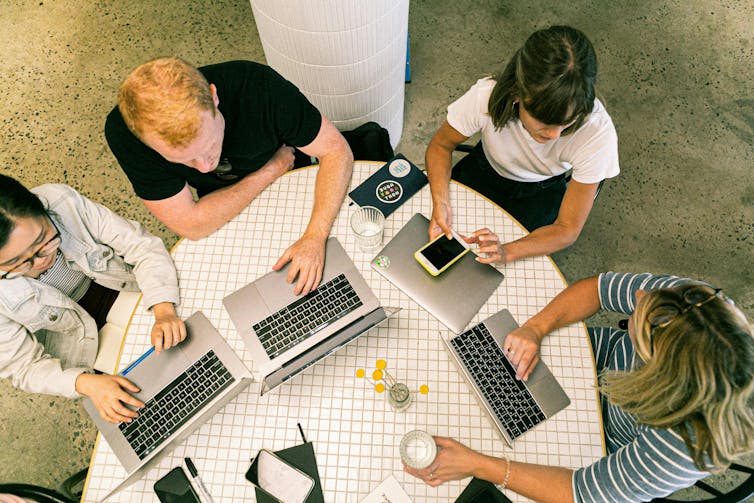
Psychological safety[15] is part of this. Regenerative workplaces are those where people can speak up, raise concerns and take reasonable risks without fear of blame.
This is where leadership really matters[16]. Organisations need to ask hard questions about the true impact of management practices: do they drive absence[17], presenteeism and turnover – or do they enable learning, growth and renewal? Rewarding managers and teams who protect well-being reduces stress, retains talent and makes organisations places people want to work.
The bottom line is, as long as work is designed like a machine to maximise output, burnout will remain its most predictable outcome. But sustainable performance is possible. It just means actually designing workplaces that protect[18] — and renew — the people working in them.
This article was commissioned as part of a partnership between Videnskab.dk[19] and The Conversation.
References
- ^ say they’re currently burned out (www.bcg.com)
- ^ workplace stress affects their mental health (www.globenewswire.com)
- ^ Frederick Taylor (www.britannica.com)
- ^ exhausting natural resources in the name of profit (www.sciencedirect.com)
- ^ motivation, engagement and well-being (www.oecd.org)
- ^ once they are spent at work (www.frontiersin.org)
- ^ depletion, disengagement and ultimately burnout (pmc.ncbi.nlm.nih.gov)
- ^ pexels/diimejii (www.pexels.com)
- ^ CC BY (creativecommons.org)
- ^ circular economy (theconversation.com)
- ^ circular work (www.emerald.com)
- ^ employee well-being and organisational performance (wellbeing.hmc.ox.ac.uk)
- ^ renewing people’s energy and skills (www.sciencedirect.com)
- ^ pexels canvastudio (www.pexels.com)
- ^ Psychological safety (dash.harvard.edu)
- ^ leadership really matters (pubmed.ncbi.nlm.nih.gov)
- ^ drive absence (www.sciencedirect.com)
- ^ designing workplaces that protect (sloanreview.mit.edu)
- ^ Videnskab.dk (videnskab.dk)
Read more https://theconversation.com/the-workplace-wasnt-designed-for-humans-and-it-shows-269127