James Harding’s MacTaggart lecture is a passionate defence of the BBC
- Written by: Paul Tucker, Senior Lecturer in Broadcast Production, University of the West of Scotland
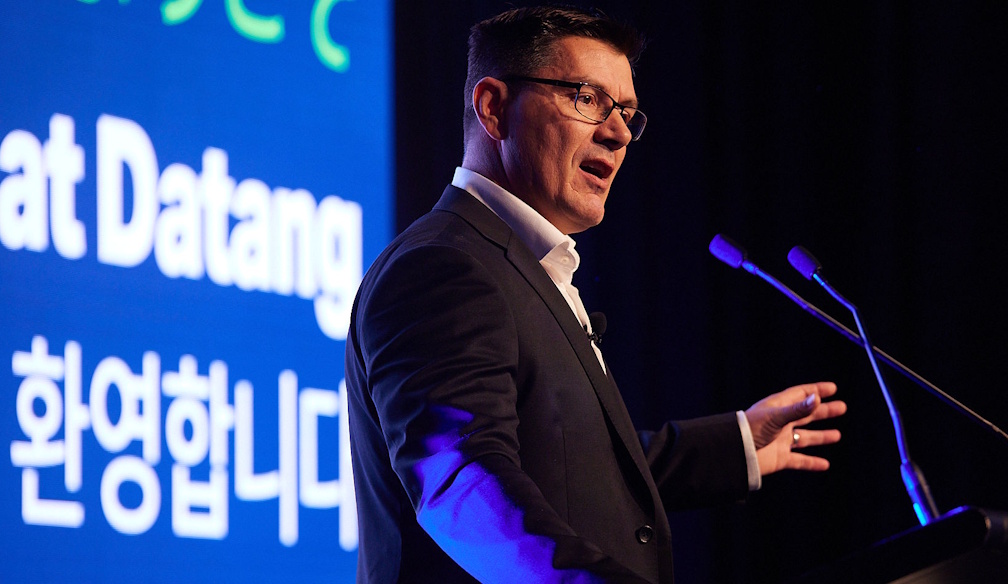
The agenda-setting centrepiece of every Edinburgh TV Festival[1] is the MacTaggart lecture, celebrating its 50th anniversary in 2025. This year’s lecture was delivered by former BBC news director James Harding[2], and billed as a speech that would examine challenges to truth and trust in the media.
Co-founder of Tortoise Media – the “slow news” organisation that has recently bought The Observer – Harding has enjoyed a long career as a journalist and was also once editor of The Times newspaper.
He isn’t really a “TV person”, so Harding seems a strange choice to deliver the 50th MacTaggart. Why not someone who has TV running through their veins, like presenter and producer Richard Osman[3]? Or someone who might reflect the MacTaggart’s beginnings as part of a festival that sought to offer a Scottish-based perspective to the the London-centric TV industry? Or someone who could at least ask the most pressing question facing TV: does it have any kind of future?
However, the organisers of the Edinburgh TV Festival promised[4] the lecture would be “a provocative, kick-ass and insightful view from a visionary leader”.
However, as you might expect from someone who named their company after the humble tortoise, it was much gentler than that, poking its head out of its shell and gently tearing off some conversational topics rather than ripping into things. That said, the lecture was a passionate defence of the BBC that argued for a drastic increase in its funding.
Harding started by describing the BBC as “the most important source of information in this country and around the world”. It was time for the government to give real independence to the BBC in the same way it did with the Bank of England in 1997.
He expressed concern that as things stand, the BBC chair is in essence appointed by the prime minister with a budget set by the chancellor. He also pointed out that should parliament choose not to renew the charter in 2027, the BBC would cease to exist.
Harding argued for change that would see the BBC chair and board of directors appointed by the board itself (which does seem a somewhat circular process) and then approved by Ofcom. The charter, once renewed, would be open-ended (much like those for universities) and any funding – licence fee or otherwise – would be agreed by an independent panel that impartially advises government and is scrutinised by parliament.
That funding, Harding said, needs to be doubled to allow the BBC to function properly. He cited the iPlayer and Media City in Salford as being bold, successful developments of the kind the BBC can only make when properly financed. He admitted that this rise in funding could not come from an increase in licence fee alone, and said something must be done about the 2.5 million households that currently don’t pay it, underlining his support for the “every household pays” model.
Harding also suggested that the quasi-independent and still-developing work of BBC Studios[5], and in particular the monetising of the BBC archive[6], could be ways of increasing income for the corporation.
He made an impassioned plea for the BBC World Service[8] to be properly funded, pointing out that it already has a bigger worldwide audience than Netflix. It could, he said, reach over a billion people in the next decade, fighting misinformation globally and providing a real source of soft power for the UK.
Harding’s arguments as to what the BBC could be in the future are perhaps more daring and contentious. He imagines “a BBC that thinks of itself more as the ‘people’s platform’ as well as a public service broadcaster, one that’s home to more varied thinking, but holds true to standards of truth and accuracy, diversity of opinion and fair treatment of people in the news”.
It would, he said, be an open platform that “would invite the BBC to think not just about how it informs and entertains, but how it educates too” – a kind of YouTube run by BBC editorial policy. This, he summed up, would be “a national investment in our future that will come back to reap multi-platform rewards that an investment in no other UK organisation can”.
I don’t think there is much I would argue with in James Harding’s MacTaggart lecture. I would just ask how all this is actually going to happen – how the debate moves out of the conference rooms of the TV festival. Harding obviously believes in the BBC. Yet when he was editor of The Times, a journalist of influence and power, he couldn’t stop the paper’s – and Rupert Murdoch’s – relentless criticism of the BBC.
We also now have an unofficial government opposition in Reform that believes, as Harding reminded the audience, that the BBC is out of touch and institutionally biased, and will be scrapped by Farage’s party should they come to power.
I agree with Harding that in a fragmented media world we must fight to preserve and properly fund the BBC. But that fight won’t be easy.
References
- ^ Edinburgh TV Festival (www.thetvfestival.com)
- ^ James Harding (www.thetvfestival.com)
- ^ Richard Osman (en.wikipedia.org)
- ^ promised (www.thetvfestival.com)
- ^ BBC Studios (www.bbcstudios.com)
- ^ BBC archive (www.bbc.co.uk)
- ^ Ian Macpherson / Alamy (www.alamy.com)
- ^ BBC World Service (www.bbc.co.uk)
- ^ Sign up here (theconversation.com)