Trump’s tariffs have finally kicked in, so what happens next?
- Written by: Maha Rafi Atal, Adam Smith Senior Lecturer in Political Economy, School of Social and Political Sciences, University of Glasgow
Donald Trump’s new international trade tariffs have landed[1]. Some are lower than others, some deals have been done, but overall they are the highest they have been in 100 years.
They are also unprecedented in the era of the rules-based trade system[2] that has been in place since 1945.
So what happens next? That’s a tricky question to answer given that the US president has already pressed the pause button[3] on this economic policy before.
But assuming that doesn’t happen again straight away, we can make some confident predictions about the consequences.
First off, the immediate economic effect will be felt by American consumers. JP Morgan, the biggest bank in the US, estimates[4] that 60% of the cost of Trump’s tariffs will be passed directly on to his fellow citizens.
And that’s just the start. Most goods bought in the US, whether they’re electrical items, cars, medical devices, processed foods or makeup sets, are made up of dozens of components, sourced from multiple countries. A finished product may therefore be “tariffed” several times before it reaches the shelf, adding to the final price rise.
Medium-sized businesses are likely to feel the most pain[5]. They have neither the global reach to reorganise their supply chains quickly nor the deep margins to absorb new costs. That means higher prices for the goods they produce.
As a result of all of this, things will get more expensive and consumer spending will fall. It’s too early to quantify the drop, but survey data shows[6] that households are already cutting back.
Businesses will also cut or delay investment in new plants, staff and product lines, as more of their revenue goes on covering higher import taxes.
These effects will be inflationary, pushing prices up. They will also be “recessionary” – in other words, they could cause a recession by cooling demand and investment.
The political irony here is striking. Trump’s election victory was fuelled in part by voter frustration[7] over high inflation early in Joe Biden’s presidency.
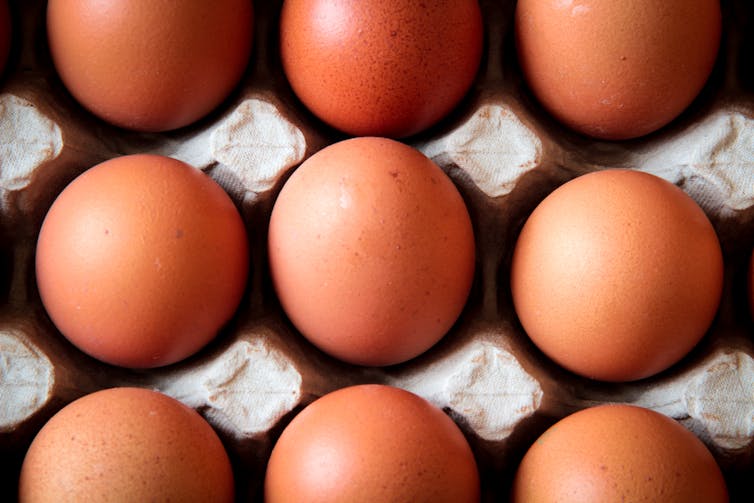
By the time of the election in November 2024, inflation had eased[8] – but the perception that Biden was linked to higher prices (often discussed with reference to the price of eggs[9] in the grocery store) lingered.
Now Trump’s policy choices look set to drive up prices again, while also risking a significant economic downturn.
A US recession would have global consequences. Mexico, China, Canada, Germany and Japan – the countries which export the most goods to the US – are particularly exposed. Together with the US, these economies account for roughly half[10] of global GDP. If US economic activity slows, and its key suppliers follow, that would be enough to trigger a global contraction.
There’s also the risk of renewed supply chain delays. Faced with uncertainty about demand, companies will slow or stop new orders.
Then, when consumers start buying again, the components needed may not be in stock, delaying production and pushing up costs further. These disruptions tend to cascade through multiple sectors, meaning the impact will be widely felt around the globe.
So how long can this tariff regime hold? In April, Trump’s so-called “liberation day” tariffs were rolled back within days under pressure from American businesses that were suddenly paying more for vital imports.
Since then, very few countries have signed deals with the US, and the ones that have secured broad agreements[12] rather than binding treaties. That means the political backlash from businesses and consumers could once again force the administration to retreat.
For now, the US is testing how far it can push this experiment in protectionism. But the risks are clear: higher prices at home, slower global growth, and a political gamble that may prove costly.
References
- ^ have landed (www.bbc.co.uk)
- ^ trade system (www.historians.org)
- ^ pressed the pause button (edition.cnn.com)
- ^ estimates (www.cnbc.com)
- ^ are likely to feel the most pain (www.marketplace.org)
- ^ survey data shows (www.surveymonkey.com)
- ^ voter frustration (blogs.lse.ac.uk)
- ^ inflation had eased (www.theguardian.com)
- ^ price of eggs (theconversation.com)
- ^ roughly half (databank.worldbank.org)
- ^ ArturTona/Shutterstock (www.shutterstock.com)
- ^ broad agreements (theconversation.com)
Read more https://theconversation.com/trumps-tariffs-have-finally-kicked-in-so-what-happens-next-262843