why a fall isn’t certain and wouldn’t help first-time buyers much anyway
- Written by: Alan Shipman, Senior Lecturer in Economics, The Open University
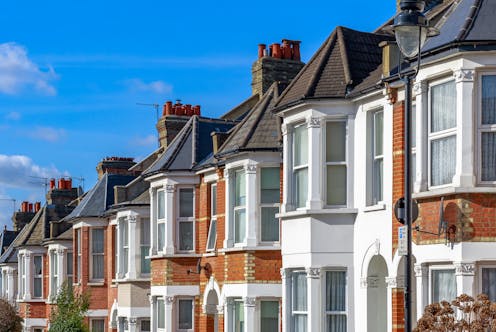
The UK remains a nation of homeowners, with two-thirds of all dwellings belonging[1] to the people who live in them. But as interest rates swiftly rise, there are fears that many of those households will soon find their mortgage payments unaffordable.
As one BBC interviewer told[2] the new prime minister: “People were worried whether they could heat their homes. They’re now worried whether they can keep their homes.”
More expensive mortgages could certainly depress the housing market, with serious effects on the wider economy. This is why governments generally try to keep house prices rising, even as they attempt to restrict inflation elsewhere. But even under these more difficult economic conditions, it’s by no means certain that house prices will actually come down significantly.
A buoyant housing market can boost the overall economy[3], because homeowner confidence leads to increased spending. Homes are also an important way of securing loans[4] for small business investment.
For more than a decade, until 2021, the Bank of England helped promote mortgage affordability with historically low[5] interest rates. And while households took on more mortgage debt over this period, the cost of repaying that debt kept falling[6] as a proportion of income.
As people took advantage of these low borrowing costs, a million more homes became owner-occupied[7] between 2015 and 2020. Thousands more used cheap buy-to-let mortgages to acquire additional properties[8] to supplement their work or pension income.
The sudden rise in costs of mortgage debt, in relation to borrowers’ income, now makes their situation unexpectedly precarious[9], even though interest rates are still much lower than they were before 2008.
Rental disagreement
For those still striving to get onto the property ladder, the problems may seem even starker. Rising house prices are no match for average incomes which haven’t risen much in real terms[10] since 2008.
The mini-boom in home ownership from 2015 to 2020 also tended to stifle political debate about renters who couldn’t afford to get on the property ladder, even though rising house prices have been driving up rent costs[11].
Meanwhile, for some younger people, there has been financial help in progressing from renting to buying from the ever-growing “bank of mum and dad”, estimated to be worth £25 billion in gifts[12] and loans from 2022 to 2024. But better-off households giving their children a lift onto the ladder has contributed to the UK’s rising wealth inequality[13].
And although successive governments have pledged to make housing more affordable by relaxing planning laws[14] to accelerate new building, their main solution has actually been to offer more help with the buying. The Conservatives’ help-to-buy schemes channelled up to £6 billion[15] in this direction. Recent cuts to stamp duty[16] were intended to give a further boost.
This delicate balancing of interests – allowing homes to become more expensive while ensuring that first-time buyers can still afford them – is tricky at the best of times. It is even harder to achieve after the turbulent reception for the new UK government’s recent mini-budget[17].
Interest rates had already risen sharply[18] since the start of 2022 as the Bank of England reacted to inflation reaching 9.9% and the projection that it will peak[19] at 11% – far above the Bank’s 2% target.
The Bank may now have to raise its base interest rate by much more than September’s rise to 2.25%[20] – already the highest since 2008 – to stop financial markets resuming their sell-off of the pound[21], which has already nudged inflation forecasts upwards.
The likely result is that new mortgages will be significantly more expensive, and harder to obtain without a larger deposit. Existing mortgages will become costlier to service for those who didn’t manage to fix a low rate before credit markets were thrown into turmoil[22].
Hazards of a house price fall
The loan affordability shock is likely to deepen a recession[23] that was already on the way[24], due to the squeeze on household spending from the cost-of-living increase.
But this does not necessarily mean house prices will drop, as fears of mortgage costs and withdrawal of cheap mortgage offers could significantly reduce demand. Higher interest rates and reduced confidence have already slowed house-building[25] activity.
The weaker pound will also make UK property, especially in large cities, more attractive to foreign buyers. The mortgage-free households[27] that account for 45% of England’s 15 million owner-occupied homes (and 36% of the total) may also be tempted to buy more property.
But if house prices do drop sharply, as some forecasts now suggest[28], it could spark a downward spiral. Struggling mortgage-holders would be forced to sell, overloading supply and pushing more borrowers into negative equity.
If houses do get substantially cheaper, first-time buyers will continue to struggle as borrowing for them too will become significantly more expensive. For a falling property ladder to come within their reach would require a downturn of extreme severity, leaving few people feeling secure.
References
- ^ belonging (www.ons.gov.uk)
- ^ one BBC interviewer told (www.bbc.co.uk)
- ^ boost the overall economy (www.bankofengland.co.uk)
- ^ securing loans (bankunderground.co.uk)
- ^ historically low (www.bankofengland.co.uk)
- ^ kept falling (www.bankofengland.co.uk)
- ^ became owner-occupied (assets.publishing.service.gov.uk)
- ^ acquire additional properties (www.landlordzone.co.uk)
- ^ unexpectedly precarious (twitter.com)
- ^ much in real terms (fullfact.org)
- ^ driving up rent costs (www.ons.gov.uk)
- ^ £25 billion in gifts (www.savills.co.uk)
- ^ rising wealth inequality (www.theguardian.com)
- ^ relaxing planning laws (www.homebuilding.co.uk)
- ^ channelled up to £6 billion (england.shelter.org.uk)
- ^ cuts to stamp duty (www.gov.uk)
- ^ recent mini-budget (theconversation.com)
- ^ risen sharply (www.icaew.com)
- ^ projection that it will peak (www.bankofengland.co.uk)
- ^ rise to 2.25% (www.bbc.co.uk)
- ^ sell-off of the pound (theconversation.com)
- ^ thrown into turmoil (www.estateagenttoday.co.uk)
- ^ a recession (theconversation.com)
- ^ already on the way (ihsmarkit.com)
- ^ slowed house-building (www.housingtoday.co.uk)
- ^ Shutterstock/GrandeDuc (www.shutterstock.com)
- ^ mortgage-free households (www.ons.gov.uk)
- ^ forecasts now suggest (www.theguardian.com)