Why Liz Truss is no Margaret Thatcher when it comes to the economy
- Written by: Craig Berry, Associate Professor in Economic Policy, UCL
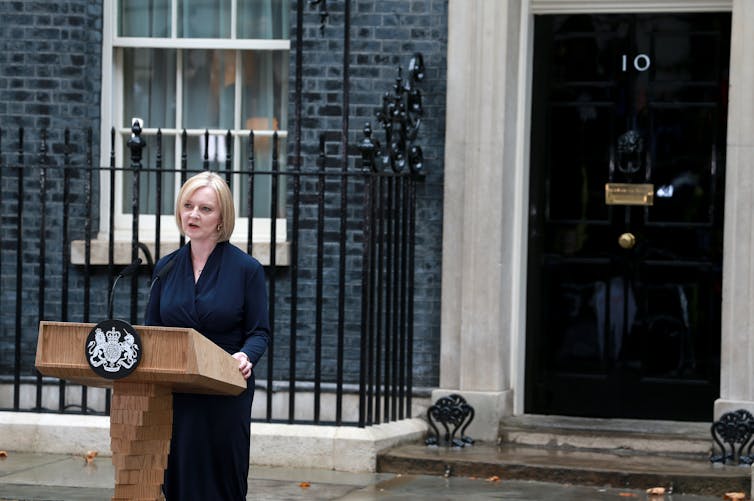
The UK’s new prime minister, Liz Truss, has made no secret of her admiration[1] of her late predecessor, Margaret Thatcher. However, anyone expecting[2] a swift return to Thatcherite policies in 2022 should probably take a closer look at Truss’s politics.
To begin with, Truss is about to oversee a significant expansion of state intervention into the economy, as it pays companies to supply energy[3] to households and businesses. The decision is expected to cost £130 billion[4] over the next two years – the biggest single spending announcement in UK history.
Thatcher aimed instead to retract the state from the economy. Privatisation of state-owned industries was at the heart of her premiership, with energy sector privatisation beginning in 1986[5] and continuing under John Major’s government.
But Truss’s plan is not renationalisation in a conventional sense. Instead it is the state being used to prop up the profits of several very large companies while subsidising consumers, shielding them all from the market.
And it comes alongside a renewed appetite for intervention across the energy sector, with the government directing investment towards new energy sources and infrastructure, as it aims to detach the UK from global energy markets.
This looks a lot like what is known as “state capitalism”, a term usually used to describe the economic policies of the likes of China or Russia rather than the UK. This approach is likely to extend beyond the energy sector, with public funds being funnelled towards supporting British companies in a bid to decrease the UK’s reliance on imported goods. We can expect the private sector to become both more British, and more entwined with government.
Elsewhere, the argument for thinking of Truss as a modern day Thatcher rests largely on their apparent indifference to inequality, and in their antipathy towards workers’ rights and trade unions.
Truss was co-author of the 2012 book Britannia Unchained[6], which infamously described the British people as “among the worst idlers in the world”. In her bid to become prime minister, she promised[7] a crackdown on trade unions considering strike action.
For her part, Thatcher genuinely believed that industrial action was an impediment to growth, having entered Downing Street on the back of a wave of strikes[8] in the 1970s.
But there is no evidence[9] that employment protection or high union density impede productivity in today’s economy. Workers’ rights might be a drag on firms’ profits (because their employees are demanding a fairer share[10]) but not their output.
The outlooks of both leaders also share a predilection for lower taxes. But even this apparent similarity is not as simple as it seems.
Compared to now, the UK had much higher personal tax rates[11] when Thatcher entered office, which she consistently sought to bring down. But she also strived to control the budget deficit and, above all, inflation, which at the time was around 13%[12]. Controlling inflation remained a defining Thatcherite mission.
We cannot say the same about Truss. The tax cuts she has promised will contribute to an enlarged deficit[13] in the years ahead, as well as increasing an inflation rate[14] which has already hit 10%. Both Treasury and Bank of England officials have been rebuked – or worse[15] – for advising caution in this regard.
It would be wrong to think, however, that the Conservative party’s embrace of state capitalism has been invented by Truss. As my colleague James Silverwood and I have argued[16], the UK has often embraced state capitalist practices.
In recent years, the banking sector was bailed out[17] after the financial crisis of 2008 (under Labour, but without Conservative opposition), exposing the state to potential losses of more than £1 trillion. Quantitative easing since has underpinned capital markets and government borrowing, with bond purchases amounting[18] to almost £900 billion.
And we cannot ignore government substituting[19] for the private sector in terms of paying wages and creating credit amid the pandemic, with the furlough scheme alone costing £70 billion[20].
My research[22] also shows how successive Conservative governments have intervened in the housing and pension industries, while also embracing industrial policy (which Thatcher disapproved of).
And while it is true that these interventions may have resulted from economic crises, it is also a fact that extraordinary policies introduced to address crisis tend to leave an imprint on economic governance more generally.
Crucially, Britannia Unchained had already told us that Truss was more than comfortable with state largesse, when it lauded the economies of Brazil, Singapore and Israel – all with far greater levels of state intervention than the UK at the time. This was not a mistake, but a deliberate re-reading of the bits of Thatcherism which were considered relevant today.
We can speculate of course, that if Truss had come to power in 1979 rather than 2022, she would have pursued an agenda identical to Thatcher. But the economy of 2022 is not the economy of 1979.
Back then, Thatcher wanted to dismantle the collectivist, Keynesian state of relatively high taxes and government spending, and replace it by embedding neoliberal ideas encompassing lower spending and market primacy in UK economic policy. But now Truss takes the reigns of a state already neoliberalised, and is discovering that state power will increasingly be needed to deal with the crises she has inherited.
References
- ^ her admiration (www.independent.co.uk)
- ^ anyone expecting (www.theguardian.com)
- ^ pays companies to supply energy (www.bloomberg.com)
- ^ cost £130 billion (www.theguardian.com)
- ^ beginning in 1986 (www.bbc.co.uk)
- ^ Britannia Unchained (www.theguardian.com)
- ^ she promised (www.theguardian.com)
- ^ wave of strikes (www.ons.gov.uk)
- ^ no evidence (assets.publishing.service.gov.uk)
- ^ fairer share (www.bankofengland.co.uk)
- ^ much higher personal tax rates (www.margaretthatcher.org)
- ^ around 13% (www.macrotrends.net)
- ^ enlarged deficit (www.ft.com)
- ^ increasing an inflation rate (ifs.org.uk)
- ^ worse (www.theguardian.com)
- ^ argued (journals.sagepub.com)
- ^ banking sector was bailed out (www.theguardian.com)
- ^ amounting (www.bankofengland.co.uk)
- ^ substituting (academic.oup.com)
- ^ costing £70 billion (www.statista.com)
- ^ Shutterstock/Fred Duval (www.shutterstock.com)
- ^ My research (journals.sagepub.com)