New Ogilvy Study Reveals a Crisis of Brand Belief in Hong Kong
Over 90% Take Punitive Action Against Brand Doubt, While 61% Have Walked Away
HONG KONG SAR - Media OutReach Newswire - 6 July 2026 - Hong Kong consumers have very low tolerance for brands and organisations that are deemed not believable, responding with rapid and decisive backlash when corporate promises trigger doubt.According to a new study on "The Believability Economy" by Ogilvy and YouGov, local residents quickly escalate from questioning claims to complaining on social media, switching to competitors, and fully disengaging. Part of a seven-market Asia Pacific initiative, the Hong Kong SAR edition of Ogilvy's "Believability Index: The Power of Proof" reveals how critical proof has become to maintaining brand survival.
Silent Disengagement Directly Threatens Revenue
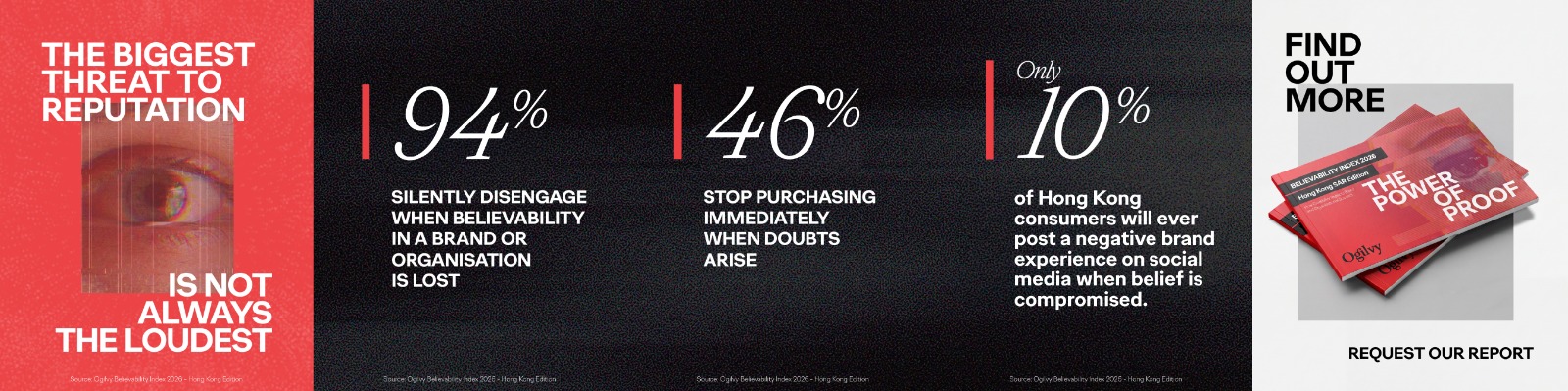
When believability falters, consumer action is almost universal. Of the 1,032 Hong Kong residents aged 18 and over surveyed between late April and early May 2026, 94% stated that they take punitive action once they harbour doubts about a brand or organisation, leaving only 6% with their behaviours unchanged. The local backlash is only slightly below the APAC average of 96%.
This belief-triggered disengagement also inflicts immediate financial consequences: 61% of Hong Kong respondents (70% in APAC) have stopped engaging with or purchasing from a brand or organisation over the past 12 months due to a lack of belief in its claims.
More importantly, silent forms of disengagement dominate the Hong Kong market. Nine in 10 Hongkongers (89%) opt for "silent disengagement", walking away without saying a word. This quiet exit also carries a severe commercial penalty: it includes 46% who stop purchasing altogether and 32% who migrate to a competitor.
"The research findings are a stark wake-up call for brands and organisations, and show believability makes or breaks consumer decisions in immediate and severe ways," said Clara Shek, President, Ogilvy Public Relations Hong Kong. "The Hong Kong findings reflect a broader trend in the Asia Pacific region: disengagement often combines quiet withdrawal with more visible signals. Brands and organisations must recognise that what they see publicly is only part of the picture — the quieter, unseen behaviours are dangerous and could be the silent killers of an organisation's success."
Vocal punishment is common. Over half (58%) of the respondents say they would take public or semi‑public action, such as:
- Telling friends, family or colleagues not to support the brand or organisation (30%)
- Reporting or flagging organisational content as misleading (17%)
- Leaving a negative review or public comment (15%)
- Actively and publicly avoid their content (14%)
- Contacting them directly to express concerns (12%)
- Posting personal experiences directly on social media (10%)
Lack of Competence and Ethics Triggers Consumer Disengagement
When consumers abandon a brand or organisation due to a breakdown of belief, the top reasons that prompted them to stop engaging or stop purchasing in the past 12 months tie directly to operational execution:
- Products and services didn't deliver what was promised (34%)
- The brand or organisation handled an issue or mistake poorly (29%)
- Poor business ethics (27%)
Drivers of Believability
In Hong Kong, believability is driven far more by the credibility of the source than by the creative style of the content, and people rely primarily on their own judgement or official sources, rather than influencers or highly-polished content. Three quarters (76%) of Hong Kong residents rely on credibility-related influences (such as credible sources and multiple sources), 62% rely on personal perception (whether information aligns with existing knowledge), 59% turn to reviews, and 43% turn to peer validation.
Across all ages, the top drivers of belief are consistently rooted in familiarity and prior experience:
- A source they already find credible (43%)
- Information that aligns with their own knowledge or experience (34%)
- Official or institutional sources (30%)
The Channel Paradox - Where Belief and Scepticism Collide
The Ogilvy Believability Index 2026 finds that mainstream media and official brand channels remain the most influential sources of increased belief in Hong Kong. Almost two-thirds (58%) of Hong Kong residents say information from mainstream media increases their belief in brands and organisations that matter to them, and half (50%) say official brand channels improve belief. Both sources were greeted with relatively minimal scepticism (7% and 8% respectively).
Influencer content and private messaging apps tell a more complex story. The study shows that 30% of Hong Kong consumers say information from social media influencers and KOLs increase their belief, but 26% express heightened scepticism. Private group chats such as WhatsApp show the same near‑equal split: 30% say these channels strengthen their belief, while 26% say they make them more doubtful. In these environments, brands and organisations aren't generating belief alone — they're generating belief and doubt in almost equal measure.
"Social media channels may be influential in reach and visibility for brands and organisations, but they are far less effective at strengthening belief," Ms. Shek said. "In fact, they often create a mix of belief and doubt - a paradox that organisations need to navigate carefully. Traditional tracking tools can create a blind spot for senior leadership as organisations run the risk of over-indexing spending on the exact platforms that are triggering scepticism."
The importance of mainstream media echoes the latest findings in South China Morning Post's (SCMP) Intersection of Influence study released on June 24, 2026. The SCMP study shows news media commands the highest attention of any channel in Hong Kong, significantly outperforming other channels (such as social media) in terms of audience focus and staying power. Sixty-one percent (61%) say news reports stay with them long after reading, and 16% use the information to make important decisions. For believability, this shows that news environments don't just attract attention; they generate intentional, lasting and active engagement in the content.
Negative Ripple Effect for Other Brands
When believability breaks, it spreads. A third (31% local; 36% in APAC) of consumers admit that when their belief in a brand or organisation is lost, they become more wary or suspicious, with 38% of Hong Kong consumers (29% in APAC) reporting that they will subsequently minimise their use of similar products or services from other brands and organisations.
Restoring Belief – Action is Louder Than Words in Hong Kong
On the bright side, 82% of Hong Kong residents (85% in APAC) say belief can be restored. Only 14% of Hong Kong residents (11% in APAC) say that once belief in a source is lost — whether an organisation, media outlet, or public figure — it can never be regained.
When it comes to restoring belief, Hong Kong consumers respond most positively to concrete action. Half (50%) say an organisation must "actively fix the issue" before they will believe them again – a requirement that ranks well above a "public acknowledgement" (40%). Furthermore, another 40% believe it is important to "demonstrate consistent accuracy."
For Hongkongers, these concrete actions carry far more weight than shifts in communication style alone. Only 29% of respondents feel that being "more transparent or further evidence-based" in their communication helps restore belief, while only 13% say "endorsements from respected individuals" helps restore belief. In other words, accountability and follow‑through are the real drivers of believability.
"Consumers are open to brands and organisations that take actions to repair that credibility. The path to redemption clearly lies in tangible action – correcting problems, publicly acknowledging mistakes and demonstrating consistency. As the findings show, accountability is the ultimate currency of belief," said Ms. Shek at Ogilvy.
"Despite the popularity of social media and digital channels, Ogilvy's Hong Kong edition of the 'Believability Index: The Power of Proof' calls for a rethink on marketing and issue management approach," Ms. Shek concluded. "To protect against silent disengagement, leaders must deliver on their core promise, tackle issues transparently, and anchor their communications in mainstream media and official channels, with mindful management of social media and influencer strategy recognising these channels' belief-scepticism double-edged impact on consumers."
Hashtag: #Ogilvy
The issuer is solely responsible for the content of this announcement.
About Ogilvy’s 2026 Believability Index: Power of Proof
The Hong Kong edition of "Believability Index: The Power of Proof" was conducted online between 22nd April - 4th May 2026. The sample comprised an online representative sample of 1,032 Hong Kong adults aged 18 years and older. Total sample size for Ogilvy's seven-market Asia Pacific Believability Index 2026 was 7,176 adults in Australia, Indonesia, Singapore, Malaysia, the Philippines, Mainland China and Hong Kong SAR (1,032). All figures, unless otherwise stated, are from YouGov Plc. The figures have been weighted and are representative of all respective market adults (aged 18+). Ogilvy designed the questionnaire in collaboration with YouGov.
About Ogilvy PR
Ogilvy PR and Influence is a global creative communications agency that partners with organisations to drive value and growth. We build brands, protect reputations, and earn attention and influence through creative storytelling informed by data, and fuelled by technology. Our specialist practice areas offer media relations, social and digital communications, external and internal stakeholder communications, issues and crisis management, and stakeholder engagement. We are the region's largest and most specialised public relations and public affairs consultancy.