Australia's June quarter national accounts show GDP doing well
- Written by: John Hawkins, Senior Lecturer, Canberra School of Politics, Economics and Society, University of Canberra
Tuesday’s national accounts show Australia ending 2021-22 on a strong note.
Gross domestic product grew by a historically robust 0.9% in the three months to June, and by an unusually-high 3.6%[1] over the year.
Australia’s economy is now more than 5% bigger than it was before COVID, a better performance than most comparable economies.
The main drivers of the 0.9% jump in activity were household spending and exports.
Household spending grew 2.2% in the quarter, exports grew 5.5%.
Each contributed about one percentage point to the growth in GDP. Working the other way was a smaller build-up of inventories (unsold stock) that lowers the amount of production needed to meet the increased demand.
Households have been saving less in order to spend more. Since the start of this year, household saving has slipped from 13.5% to a more normal 8.7%.
Spending has also been supported by the fall of unemployment, now down to a near half-century low of 3.4%[2], a low that might be sustained for quite a while[3].
In good news for government tax revenue, the value of Australia’s mineral exports also climbed due to higher commodity prices.
Price isn’t taken into account in compiling the most-widely quoted GDP measure, which is “real” GDP, a measure of volumes rather than prices.
Australia’s terms of trade[4] (the ratio of export prices to import prices) reached an all-time high.
Investment spending by companies continued to remain flat[5], after rebounding from COVID last year.
As highlighted[6] by ACTU secretary Sally McManus, the share of national income accruing to labour remains at a near 60-year low.
In the June quarter profits again grew faster than wages. It remains to be seen whether initiatives from the Jobs and Skills Summit[7] will do much to change this.
Today’s good-looking news may not be a good guide to the future.
The three months to June were barely affected by the Reserve Bank’s five successive interest rate rises that began in May.
Monetary policy is famously said to have “long and variable lags[8]”.
The Reserve Bank is almost certainly not done with interest rate increases. On Tuesday it said it expected to increase rates “further over the months ahead[9]”.
But it also said it was “not on a pre-set path”.
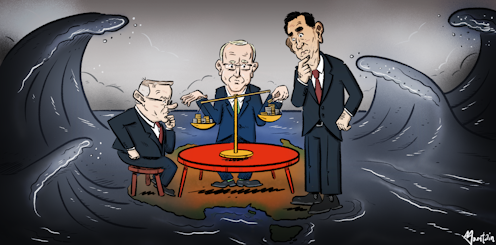
The Bank has to navigate between the Scylla[10] of the inflation it would get from not lifting interest rates enough and the Charybdis[11] of the recession it would get from lifting them too much. It is trying to find a Goldilocks path of “just right”.
As it happens, there’s a piece of news that should gladden its heart in the national accounts. Last year, it was giving the impression it wouldn’t lift rates until wage growth took off. This year in May it lost patience and lifted rates anyway, saying its business liaison program suggested companies were starting to pay more.
The national accounts show the compensation of employees (wages plus super) grew 7% over 2021-22, well above the official wage growth figure of 2.6%[12].
It might be beginning to get what it wanted.
References
- ^ 3.6% (www.abs.gov.au)
- ^ 3.4% (www.abs.gov.au)
- ^ quite a while (theconversation.com)
- ^ terms of trade (www.rba.gov.au)
- ^ flat (www.abs.gov.au)
- ^ highlighted (www.abc.net.au)
- ^ Jobs and Skills Summit (treasury.gov.au)
- ^ long and variable lags (www.jstor.org)
- ^ further over the months ahead (www.rba.gov.au)
- ^ Scylla (www.britannica.com)
- ^ Charybdis (mythology.net)
- ^ 2.6% (www.abs.gov.au)
Authors: John Hawkins, Senior Lecturer, Canberra School of Politics, Economics and Society, University of Canberra