what passengers like about Uber
- Written by: Mary Tate, Research Fellow (DECRA), Information Systems, Queensland University of Technology
Uber’s dramatic rise has been accompanied by criticism, including allegations of predatory pricing[1] and flouting of safety[2] and employment[3] laws.
Of course the flipside of this is that Uber allows ordinary people to share and monetise the spare capacity of their assets – in this case their car. It means fewer cars on the road and extra cash for anyone who becomes an Uber driver.
My ongoing research aims to connect specific, observable features of a service with a consumer’s personal value system – the underlying reason why the customer chooses the service.
Discussions with Uber riders bring out a wide range of opinions about the platform, especially when it comes to ethics.
Read more: People power is finally making the gig economy fairer[4]
People don’t necessarily buy washing powder just because they need washing powder. They buy it because they value the experience of clean, fresh-smelling clothes and a deeper emotional sense that they are caring for themselves and their families.
Similarly, many people don’t just take Uber because they want a ride, but because they want to contribute to a social good at the same time.
What makes consumers choose Uber? One of the reasons is a generational shift in consumption patterns away from globalisation and towards the “sharing economy[5]” in which consumers value access to services, rather than individual asset ownership, and seek out local, original, trusted and authentic goods and services.
Talking to riders
Together with masters student and Uber driver Michael Hunter, I have talked to Uber riders about what they value.
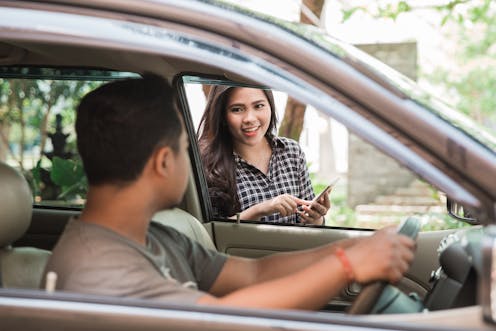
On one level, Uber is all about a reliable, professional ride in a clean and comfortable car. But it’s more complicated than that.
Consumers felt they were in a peer-to-peer relationship with the driver, and many felt conflicted about this. “It’s not a social relationship,” said one rider.
Another commented on the sense of faux friendliness that drivers sometimes showed with the aim of getting a good rating:
I feel uncomfortable having to socialise with the driver. They offer creepy attempts to make the experience positive.
They nevertheless liked the personal accountability of individual ratings, as “it gives me a sense of honesty”.
Consumers loved the transparency of the digital platform. There was no ambiguity about price, pick-up location, arrival time and driver rating. Even the licence plate number of the car was provided.
This led to a comforting sense of financial and physical security. “I don’t feel any unease,” said one rider.
Read more: Will Australians ever give up Uber?[6]
Uber is a major contributor to perceived value on a range of dimensions. “If Uber can show me interactively where my driver is and how many minutes away,” reasoned one rider, “why can’t my bus company or a taxi company?”
This sets a new bar for “transport as a service[7]”.
Interestingly, consumers also represented the full spectrum of viewpoints about the ethics of Uber. Some were positive: “The world has changed. It’s the most beneficial means of transport for everyone involved.” Some felt that that Uber opened up new employment opportunities: “it’s a source of employment for students”.
These resonated with riders’ underlying values of altruism, ethical consumption, reduced consumption and social good. However, they were conflicted as to the extent to which Uber exemplified these values.
Some questioned the ethics of Uber and the precarious nature of driver employment. “Uber gouge their drivers. The costs of driving are not covered by the fares.” This cuts to the heart of the “sharing” versus “sharewashing[8]” dilemma.
Hearts and mind
Uber is the same as a taxi, but different. Customers of “sharing economy” services are trying to make sense of changing social and economic contexts of service delivery, and it seems that at least some of them take these into account in their service choices. Certainly our riders were painfully aware of the interpersonal complexities of “sharing” when it also involves money and ratings.
At a wider level, several of our riders genuinely believed that Uber represented a social good. Others were not so sure and, as a result, were more hesitant about choosing to ride with Uber. It seems many consumers are developing a more sophisticated understanding of sharing and the dangers of “sharewashing”.
Therefore sharing economy services need to win the hearts and minds – and business – of their customers by showing they share their deeply held values.
References
- ^ predatory pricing (jalopnik.com)
- ^ safety (thewest.com.au)
- ^ employment (www.ft.com)
- ^ People power is finally making the gig economy fairer (theconversation.com)
- ^ sharing economy (www.weforum.org)
- ^ Will Australians ever give up Uber? (theconversation.com)
- ^ transport as a service (www.acaresearch.com.au)
- ^ sharewashing (simplicable.com)
Authors: Mary Tate, Research Fellow (DECRA), Information Systems, Queensland University of Technology
Read more http://theconversation.com/the-same-but-different-what-passengers-like-about-uber-101676