Cocktail Party vs. Sit-Down Dinner: When Finger Food Is the Better Choice
There's a moment every event planner knows well. You've locked in the date, you've got your guest list, and then comes the question that sends everyone into a quiet spiral: How are we feeding these people?
It sounds simple, but it rarely is.
The choice between a cocktail-style spread with finger food and a traditional sit-down dinner shapes almost everything about your event, the mood, the budget, the venue layout, the number of staff you need, even how much your guests enjoy themselves. Get it right, and the food becomes part of the experience. Get it wrong, and it's all anyone talks about on the way home.
So let's take an honest look at both options, and when finger food catering is genuinely the better call.
What Each Format Actually Delivers
A sit-down dinner puts guests in assigned seats, usually with a set menu, served in courses by wait staff. It's structured, it's formal, and it signals to your guests that this is a significant occasion. Think gala fundraisers, awards nights, or a wedding where the couple wants every moment of the evening to feel considered and controlled.
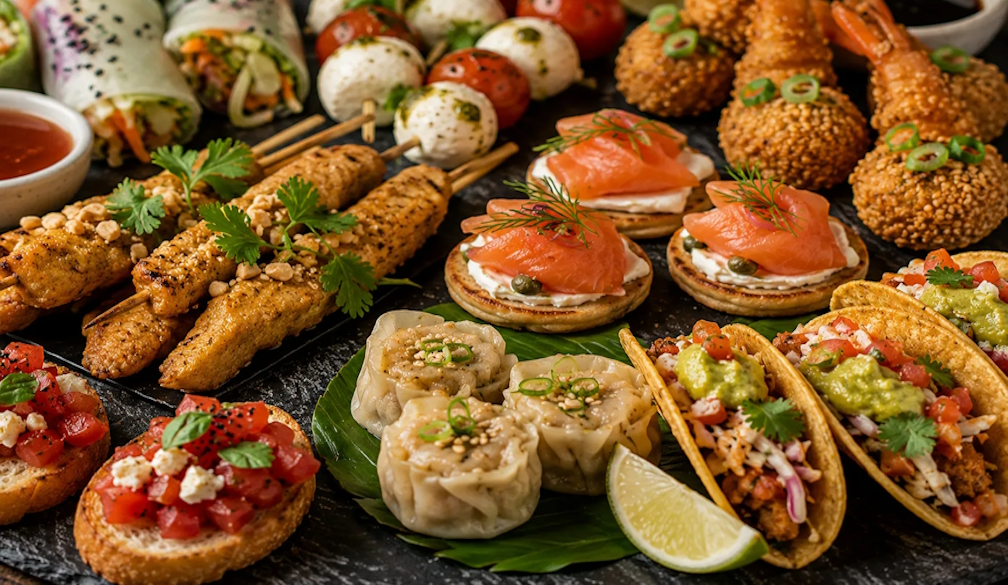
A cocktail-style event with finger food does the opposite. Guests move around. They graze. They stop to talk to someone they haven't seen in years, grab a passing prawn skewer, and drift toward the next conversation. The food keeps them going without anchoring them to a chair.
Both are valid. Both have a place. The question is which one actually fits what you're trying to achieve.
When Finger Food Wins
1. When Your Event Is About Connection
If your primary goal is for guests to meet, mix, and build relationships, whether that's a corporate networking night, a product launch, a milestone birthday, or an engagement party, a cocktail format almost always outperforms a seated dinner.
Research on event psychology shows that the free-flowing structure of a cocktail gathering is precisely what enables meaningful social interaction. Without a fixed seat, guests naturally circulate, approach new groups, and have more varied conversations across the evening. A dinner, by contrast, locks most people into the same four or five conversations for two hours.
Industry experts confirm this pattern: cocktail-style events are the clear choice when socialising and networking are the point of the gathering, while seated dinners make more sense when the agenda, speeches, presentations, formal announcements, requires everyone in their chair and paying attention at the same time.
Finger food makes all of this possible. It travels well through a crowd, it doesn't require cutlery, and it gives guests a natural reason to keep moving rather than settling in for the night.
2. When You Have a Larger Guest List
The logistics of feeding 150 or 200 people a plated three-course meal are significant. You need enough servers to handle simultaneous table service, a kitchen setup capable of producing that volume without meals going cold, and a venue with the right floor space for all those tables.
Cocktail catering sidesteps much of this. Event seating guidelines suggest that for a cocktail-style event, you only need seating for around half your guests, since only about a third of attendees will be sitting at any given moment. That frees up significant venue space, which either reduces your venue costs or lets you invite more people into the same room.
For larger headcounts, the staffing ratio also works in your favour: a cocktail reception typically requires one server per 25 guests for passed finger food, compared to one server per 15–20 guests for a plated sit-down dinner. That difference adds up quickly when you're running an event for 100 people or more.
3. When Your Budget Needs to Work Harder
Let's talk honestly about cost, because it matters.
According to catering industry data, a high-end sit-down dinner can cost $120 or more per person, while finger food catering typically runs $14–$18 per person. Even for mid-range options, the average wedding sit-down catering cost in the US sits around $70 per guest for food alone, and closer to $85 when you add drinks.
Finger food catering won't always be the cheapest option on a per-bite basis, but when you factor in reduced staffing needs, lower furniture hire, and greater flexibility with venue choice, the total cost picture looks very different.
One practical note: choose your caterer carefully and talk through quantities. A well-planned finger food menu accounts for the fact that guests at a cocktail event tend to eat more than expected, particularly when the event runs longer or coincides with a meal time. A good caterer will guide you on this.
4. When the Venue Doesn't Suit a Seated Dinner
Not every great event space is built for rows of round tables. Rooftops, galleries, warehouses, outdoor gardens, heritage buildings, these spaces often have the atmosphere you're looking for, but they don't always have the floor plan to seat 120 people for a four-course meal.
Cocktail catering opens up your venue options considerably. When you remove the need for full table settings and formal service runs, a much wider range of spaces become workable, often more interesting spaces, at better price points.
When a Sit-Down Dinner Is the Right Answer
To be fair: there are events where a seated dinner is clearly the better fit.
If your event has extended formal elements, a keynote speaker, an awards presentation, a live performance people need to be seated for, a sit-down dinner gives you control over the room that a cocktail format can't match.
If your guest list includes a significant number of elderly guests, guests with mobility challenges, or young children, a seated dinner removes the discomfort of standing for several hours. (Cocktail events can accommodate this with good seating strategy, but it requires more planning.)
And if the event is genuinely a celebration of a meal, an anniversary dinner, a client thank-you, a Christmas banquet, then the food is the event, and a seated experience honours that.
The Hybrid Approach
Worth mentioning: you don't always have to choose one or the other.
Many events work well as a combination, cocktails and finger food for the first hour or two while guests arrive and mix, followed by a shorter seated component for speeches or a main course. This gives you the social energy of a cocktail format early in the evening while still providing the structure of a seated dinner when you need the room's attention.
Talk to your caterer about what a hybrid menu might look like. A good catering team will help you sequence the food so the transition between formats feels natural rather than abrupt.
Questions Worth Asking Before You Decide
Before you book, run through these honestly:
- What's the primary goal of this event, celebration, connection, recognition, or entertainment?
- How many guests are you expecting, and what's your venue like?
- Are there guests who will need to be seated throughout?
- Do you have formal program elements that require everyone's attention at the same time?
- What's your total catering budget, including staff?
The answers will usually point you in a clear direction.
A Final Word
There's no universally right answer between a cocktail party and a sit-down dinner. But for a wide range of events, networking functions, product launches, milestone celebrations, larger guest lists, interesting venues, and tighter budgets, Sydney finger food catering delivers something a plated dinner simply can't: a room full of people who are moving, talking, and genuinely enjoying themselves.
When the food fits the format, guests don't notice the catering. They just noticed that the evening felt effortless.
That's exactly where you want to be.


 Business Daily Media