Why Traditional Demand Forecasting Is Failing Retailers in Volatile Markets
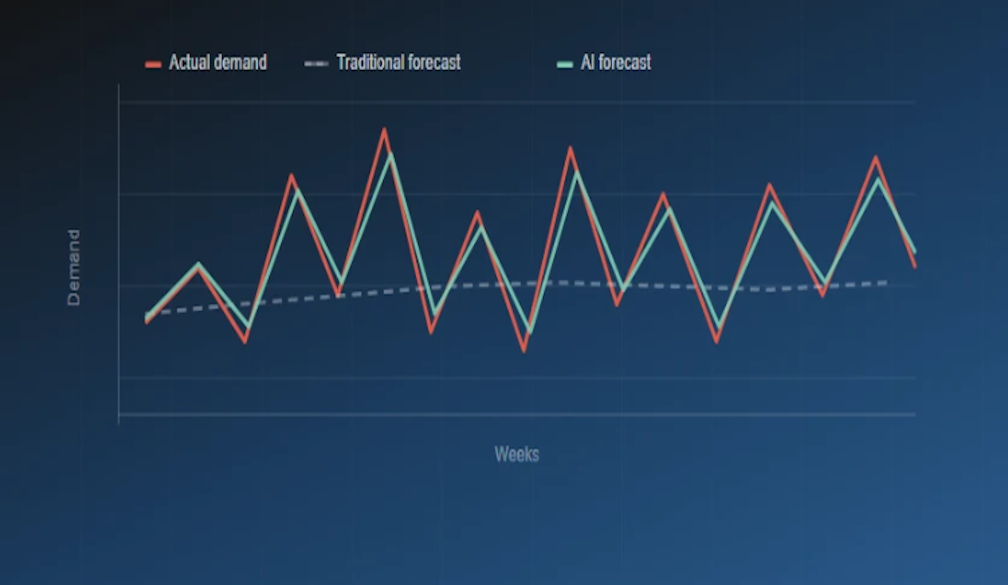
Supply shocks, shifting consumer behaviour, and compressed lead times have exposed the limits of spreadsheet-driven forecasting. Here's what forward-thinking retailers are doing instead — and why the switch is urgent.
For most of retail's modern history, demand forecasting worked well enough. You took last year's sales, applied a seasonal index, added a growth assumption, and handed the resulting spreadsheet to your buying team. In stable markets with predictable supply chains, this approach was perfectly adequate.
That world no longer exists. The past several years have delivered a rapid sequence of demand disruptions — global supply shocks, inflationary shifts in consumer spending, viral social trends that spike product demand overnight, and post-pandemic behaviour that defies historical patterns. In this environment, traditional demand forecasting software built around historical averages is producing forecasts that are structurally wrong, with measurable consequences for retailers who rely on them.
The good news: a new generation of tools is built specifically for volatile conditions. But to understand why they matter, it helps first to diagnose exactly where the old approach breaks down.
The Five Core Failures of Traditional Forecasting
Traditional retail demand planning relies on a set of assumptions that were always simplifications — and which have become dangerously inadequate. Here are the five most consequential failure modes:
1. Backward-looking by design
Classic forecasting models take the past as the template for the future. When demand behaviour changes — new competitors entering a market, shifting demographic preferences, a macro-economic shock — the model has no mechanism to detect the change until weeks or months of data accumulate. By then, the damage is done: wrong stock levels across the estate, markdowns on over-ordered lines, and missed revenue on under-ordered ones.
2. Inability to process unstructured signals
A product going viral on social media can triple demand in 72 hours. A weather event can collapse footfall for a week. A competitor closing a nearby store can permanently redistribute local market share. None of these signals appear in a historical sales spreadsheet, yet all of them profoundly affect how much inventory a store needs. Traditional tools are blind to them entirely.
3. Aggregate forecasting that masks location variance
Many retail chains still forecast at the category or brand level and then distribute stock according to fixed allocation ratios. In practice, demand patterns vary enormously between store locations — by demographic, local competition, store format, and even micro-weather. Aggregate forecasts inevitably mean some stores are overstocked while others run out, even when the chain-wide total is accurate.
4. Static safety stock calculations
Traditional safety stock is typically set once — during an annual buying cycle — based on average lead times and average demand variability. In volatile markets, both of these inputs change constantly. The result is safety stock that is simultaneously too high for stable categories and dangerously too low for volatile ones. Poor inventory demand prediction at this level is one of the primary drivers of excess working capital.
5. Slow feedback loops
Weekly or monthly planning cycles mean that by the time an error in the forecast is identified and corrected, the window to act has often closed. A stockout that starts on a Wednesday won't be visible in the weekly report until the following Monday — and won't generate a corrective replenishment order until Tuesday. That's five days of lost sales on a fast-moving product.
The compounding problem: Each of these failures is significant on its own. In volatile markets, they interact and amplify each other. A backward-looking model that misses a demand signal, distributed via aggregate allocation ratios with stale safety stock, reviewed on a weekly cycle — in such conditions, forecast errors don't just add up; they multiply.
What AI-Powered Forecasting Does Differently
Modern AI forecasting tools are built on a fundamentally different architecture. Rather than fitting a simple trend line to historical data, they use machine learning models trained on dozens of input variables simultaneously — and they update continuously as new data arrives.
The key differences that matter most for forecasting accuracy in retail are:
- Granular, location-level forecasting: AI models generate predictions at the SKU-store level rather than rolling up from category averages, automatically accounting for the unique demand profile of each location.
- Continuous model retraining: Instead of a fixed model refreshed annually, machine learning systems retrain on new data daily or weekly, making them inherently adaptive to shifts in underlying demand patterns.
- External signal integration: The best platforms ingest weather forecasts, local event calendars, social trend data, and economic indicators alongside sales history — enabling the model to anticipate demand changes before they show up in the till.
- Dynamic safety stock: Rather than a fixed buffer, AI-driven systems calculate safety stock continuously based on current lead-time variability and recent demand volatility for each specific SKU and location.
- Anomaly detection: Automated alerts when actual sales diverge from forecast by more than a defined threshold, triggering human review before a small error becomes a large stockout or overstock event.
Traditional vs. AI-Driven Demand Forecasting: Key Differences
For retail leadership teams evaluating a shift in their planning approach, the following comparison captures the operational and financial implications across the dimensions that matter most.
|
Capability |
Traditional Method |
AI-Driven Approach |
Typical Improvement |
|
Forecast granularity |
Category or brand level |
SKU × location × week |
15–40% reduction in location-level error |
|
Model update frequency |
Annual or seasonal refresh |
Daily or weekly retraining |
Faster adaptation to demand shifts |
|
External signal inputs |
None — internal sales only |
Weather, events, social, macro |
Earlier detection of demand spikes |
|
Safety stock logic |
Fixed, manually reviewed |
Dynamic, per-SKU calculation |
10–20% reduction in safety stock cost |
|
Replenishment trigger |
Weekly buyer review |
Automated, exception-based |
3–5× faster signal-to-order cycle |
|
Promotional uplift modelling |
Rules-of-thumb multipliers |
ML model trained on promo history |
20–35% better promo forecast accuracy |
|
New product forecasting |
Analogue matching — manual |
Automated analogue + attribute ML |
Reduced new-launch stockouts |
"A forecast built on last year's data assumes the future will resemble the past. In volatile markets, that assumption has become a liability rather than a foundation."
Where Traditional Forecasting Still Has a Role
It would be misleading to suggest that AI replaces every aspect of retail demand planning. In practice, the most effective retailers use a hybrid approach that applies the right tool to the right problem.
Simple, stable, high-volume categories with long, predictable histories are well served by traditional statistical models. Where AI adds the most value is in categories with high demand volatility, seasonal complexity, or strong sensitivity to external variables. These are also, not coincidentally, the categories where forecasting errors are most costly.
Human judgment remains essential for strategic decisions — range planning, new market entry, major promotional strategy — that sit outside the training data of any model. The role of the retail planner evolves from maintaining spreadsheets to interpreting AI outputs, setting guardrails, and managing the exceptions that the model flags for review.
The transition to AI demand forecasting software works best when it is positioned as augmenting the planning team's capability — giving planners better inputs and faster feedback — rather than replacing planning expertise entirely. Teams that embrace this framing adopt new tools faster and generate better results.
Practical Steps for Retailers Ready to Upgrade
For retail operations and technology leaders evaluating a move to more sophisticated demand forecasting software, these steps represent the highest-value actions to take first:
- Map your highest-volatility categories. Start by identifying the 20–30% of your assortment where forecast error is most damaging — typically high-velocity, trend-sensitive, or heavily promotional SKUs. These are your pilot categories and the ones where AI tools will deliver the fastest ROI.
- Assess data readiness before selecting a platform. Most AI forecasting platforms require at a minimum two years of clean transactional sales data, consistent SKU master data, and reliable location hierarchies. Audit this before committing to a vendor.
- Insist on explainability. The best tools don't just produce a number — they show planners why a forecast has changed and which inputs drove the change. This is essential for building team confidence and catching model errors before they cascade.
- Set clear accuracy benchmarks from day one. Define what good looks like — mean absolute percentage error (MAPE) targets by category — before implementation begins. This makes it possible to evaluate progress objectively and hold the platform accountable.
- Plan for a parallel-run period. Running the AI forecast alongside your existing process for 8–12 weeks, before switching over, lets the team calibrate trust and identify the categories where the model needs adjustment.
On vendor selection: When evaluating platforms, prioritise those with proven retail-specific implementations, out-of-the-box integration with your existing ERP and POS systems, and transparent methodology. Generic forecasting tools built for other industries rarely account for the specific dynamics of retail — promotional seasonality, markdown cycles, and range change transitions — that most affect inventory demand prediction accuracy.
The Urgency Is Real
Retail markets are not going to become less volatile. The competitive, macroeconomic, and consumer behaviour forces that have made demand forecasting difficult are structural, not temporary. Retailers who continue to rely on backward-looking, aggregate, manually reviewed forecasting processes are accepting a growing structural disadvantage.
The transition to AI-powered retail demand planning is no longer a speculative technology bet — it is a proven operational upgrade with measurable returns in inventory efficiency, markdown reduction, and on-shelf availability. The retailers implementing it now are building a compounding advantage in forecasting accuracy that will be very difficult for slower movers to close.


 Business Daily Media