Football has a real fossil fuel problem – and it’s not sustainable
- Written by: Daniel Svensson, Lecturer in Sport Management, Malmö University
In 1958, Brazil won the men’s Fifa World Cup in Sweden. The team, which included a 17-year-old Pelé, stayed in a modest country hotel and travelled by train or bus to small stadiums in cities such as Uddevalla and Göteborg.
Fan attendance was fairly low for that 16-team tournament. And so too was the the ecological impact of the event – especially compared to the 2026 World Cup[1] which will see 48 teams and millions of supporters travel to and across North America.
For while football’s global reach is often highlighted as a positive thing that brings the world together, the beautiful game risks having a rather ugly impact on the planet[2].
This is partly down to ambitious plans to expand almost every aspect of elite football – more money, more matches, more tournaments, more fans – that have accelerated over recent decades[3]. This could be seen as a positive development for anyone who enjoys football, but it also has some problematic consequences[4].
The expansion of international competitions for example, has led to increasing carbon dioxide emissions from football-related travel as teams, supporters and media representatives fly around the globe following the game.
A recent study estimated that as part of the growing ecological footprint of international sport, global football now has a carbon footprint[5] similar to that of Austria.
So the high number of international matches, as seen in the remodelled Fifa men’s Club World Cup, the expanded men’s Euros of 2024 and the forthcoming men’s World Cup in 2026 challenges both the health of the players[6] and the health of the planet.
These issues all point in the same direction – prioritising profit and growth over people and planet[7], and developing a dependence on the fossil-fuel economy[8].
There are plenty of examples. Oil-rich Saudi Arabia for instance, is often accused of sportswashing, but was named as host for the 2034 World Cup and continues to invest in the English Premier League[9]. The 2022 Fifa World Cup in oil-rich Qatar was criticised[10] for the environmental impact of new stadiums, new infrastructure and the use of cooling systems in the extreme heat.
Then there’s Fifa’s sponsorship deal with Aramco, a company estimated to be responsible for 4%[11] of global greenhouse gas emissions since 1965. All of these are strong signs that fossil-fuelled growth in the economics of football has been normalised.
Some supporters and campaign groups have been criticising[12] this development for a while now. But how is football responding?
Well, recently Fifa announced the creation[13] of its own “peace prize” to recognise those who “unite people, bringing hope for future generations”. But while that ambition may sound admirable, the actions of global football suggest the opposite.
For instead of bringing hope, football is accelerating climate change through its a problematic dependence on fossil-fuel sponsorship. Research suggests that the sport also displays a distinct lack of support[14] for those countries that are most severely affected by climate change.
There are though, some clubs doing their best to take environmental sustainability seriously. FC Porto, Real Betis and Malmö FF are all involved in the “Free Kicks” project[15], which requires clubs to assess their environmental performance in terms of things like energy savings and use of resources.
Their work shows that it is possible to combine top-level football with sustainable practices and good governance. And if Fifa is serious about bringing hope to future generations, it may want to learn from some of the people who have done precisely that.
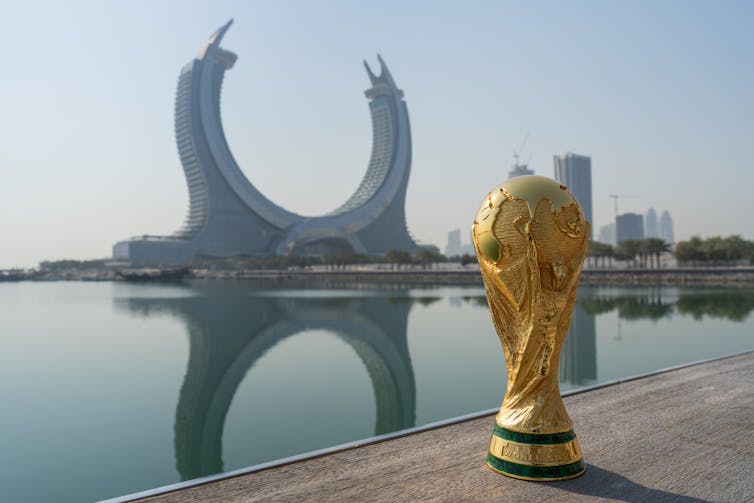
Reducing the size and frequency of large international events[17] would be a good start. So too would organising fixtures in such a way as to minimise their carbon footprint.
If all of this means accepting a deceleration in the expansion of global football in a bid to become more sustainable, would that really be so bad[18]?
After all, those who saw a 17-year-old Pelé in Sweden in 1958 did not know about the coming climate crisis. But the football they followed back then was a lot more compatible with sustainable development than the sport is today.
References
- ^ World Cup (theconversation.com)
- ^ impact on the planet (doi.org)
- ^ accelerated over recent decades (www.taylorfrancis.com)
- ^ some problematic consequences (doi.org)
- ^ carbon footprint (www.sgr.org.uk)
- ^ health of the players (www.fifpro.org)
- ^ over people and planet (doi.org)
- ^ dependence on the fossil-fuel economy (www.badverts.org)
- ^ English Premier League (www.tandfonline.com)
- ^ was criticised (www.theguardian.com)
- ^ responsible for 4% (www.playthegame.org)
- ^ criticising (www.tandfonline.com)
- ^ announced the creation (www.theguardian.com)
- ^ lack of support (www.tandfonline.com)
- ^ “Free Kicks” project (www.free-kicks.eu)
- ^ Fitria Ramli/Shutterstock (www.shutterstock.com)
- ^ large international events (www.tandfonline.com)
- ^ really be so bad (urn.kb.se)
Read more https://theconversation.com/football-has-a-real-fossil-fuel-problem-and-its-not-sustainable-270400