how money took over English football
- Written by: Robin Ireland, Honorary Research Fellow, University of Glasgow
It’s almost too easy to make the case that men’s football in England has become overly commercial. At the start of this season, one Premier League striker cost £125 million. And with an annual TV broadcasting deal worth £1.25 billion, more money is flying around the top level of the sport every year.
But it hasn’t always been this way. So how has the sport[1] become so dominated by commerce?
This was what I wanted to find out when I started looking into the history of the club[2] I have supported ever since I was a young student in the 1970s. And it turns out that Norwich City is a good example[3] of a side which has tackled the various economic factors that have transformed English football over the past five decades.
In the 1970s for example, those factors were often a challenge[4] for businesses and households, with high inflation, high unemployment and slow economic growth.
Football clubs were not immune, and it was not an easy task to keep them going as sustainable businesses (especially when hooliganism and violence[5] were lurking outside – and sometimes even inside[6] – the stadium).
It was during that decade (April 1977) that Norwich City employed its first ever commercial manager, Nigel Mackay, who was fully aware that the existence of his very role was potentially upsetting to football purists. But it turned out to be a well-timed appointment.
Two years later, the Football Association allowed clubs[7] to put sponsors’ names on players’ shirts. Four years after that, in July 1983, a meeting of Football League chairmen agreed a television deal with the BBC and ITV which allowed shirt advertising to appear on TV screens for the first time.
Norwich City’s first shirt sponsorship deal[8]was a three-year contract with a local double-glazing company, worth £50,000 a year, which was considered a milestone in the Norfolk club’s history.
Other clubs were a little more ambitious. And as football clubs continued to try to maximise their income, Tottenham Hotspur FC became the first club to be floated on the stock market[9] in 1983.
A league of their own
The 1980s was a decade which saw a series of football related tragedies, including the Bradford fire in May 1985[10] which led to 56 deaths, and the deaths of 39 fans at Heysel in Brussels just 18 days later.
At the end of the decade, the horror of the Hillsborough disaster[11] in April 1989, when 97 Liverpool fans died, proved a turning point both in how football was perceived, and how it was governed.
In 1991, the Football Association proposed[12] all-seater stadiums for safety reasons, and a radical transformation of the sport to enable it to develop its commercial potential while leaning towards more affluent consumers.
And while Margaret Thatcher had been deposed as leader of the Conservative party in November 1990, her legacy of free market expansion[13] and the sale of national assets to private investors was mirrored in the world of football.
The decision to allow the top 22 clubs to break away to form a new elite league in 1992 was a victory for those who sought to exploit and commodify[14] football.
That year the “new” top division of English football launched its inaugural season in a fizz of colour and noise. The whole entertainment extravaganza borrowed much from American sport[15] including exciting camera angles, trenchant pundits and new kick-off times to suit television audiences and advertisers.
And the US idea of mixing up television[16], commercial sponsorship and sport was clear to see as the media mogul Rupert Murdoch acquired the broadcasting rights to live coverage of the Premier League – using it to build his global audience for paid-for satellite television[17].
There were, of course, also increased ticket prices for those fans still wanting to attend matches at their local ground.
Winners and losers
Remarkably (it seems now), Norwich City were the unlikely leaders of the Premier League for the majority of its first season, before being deposed by Alex Ferguson’s Manchester United. And as others have mentioned[18], the financial reality in today’s game is that clubs like Norwich, Leeds United, Burnley and Ipswich Town are unlikely to match their successes of the past.
For its part, Norwich City, like many other English clubs[19], ended up turning to American ownership.
Before that, it was the famous TV cook Delia Smith and her husband who helped to bail their local club out of one of their periodic financial crises in 1997[20]. The couple remained majority shareholders on the club’s board for more than 25 years, and probably never originally planned to hand over their beloved club to a US consortium[21] in March 2025.
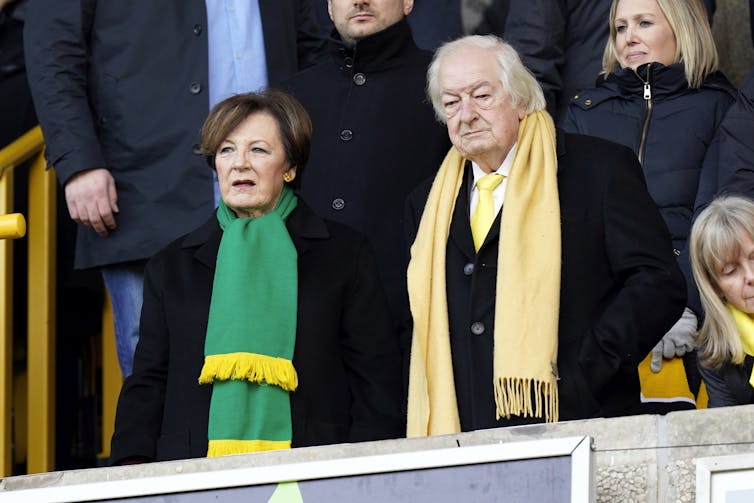
In many ways they were bowing to the inevitable. For the English Premier League, with its huge broadcasting revenues[22] and sponsorship income[23], looks more like an exclusive club with every season that passes.
Fans have been transformed into consumers of a global entertainment product, at the expense of the competition and excitement which the new Premier League had promised. Success is now fundamentally bought with the vast riches[24] generated by television, commercial income and the deep pockets of billionaires.
The result has pros and cons. As Delia Smith said herself[25]: “There’s two ways to look at it. One is that the Premier League is the best in the world and everybody lauds us and our competition, but in another way we’ve lost so much of what football is. I think that’s a bit sad.”
References
- ^ sport (theconversation.com)
- ^ history of the club (eprints.gla.ac.uk)
- ^ good example (inews.co.uk)
- ^ a challenge (www.tandfonline.com)
- ^ hooliganism and violence (journals.sagepub.com)
- ^ sometimes even inside (www.youtube.com)
- ^ allowed clubs (kittedoff.wordpress.com)
- ^ first shirt sponsorship deal (ontheballcity.co.uk)
- ^ floated on the stock market (www.independent.co.uk)
- ^ Bradford fire in May 1985 (www.tandfonline.com)
- ^ Hillsborough disaster (www.bbc.co.uk)
- ^ proposed (www.terraceedition.com)
- ^ free market expansion (papers.ssrn.com)
- ^ to exploit and commodify (aquila.usm.edu)
- ^ American sport (journals.sagepub.com)
- ^ mixing up television (journals.sagepub.com)
- ^ paid-for satellite television (journals.sagepub.com)
- ^ others have mentioned (www.nytimes.com)
- ^ many other English clubs (theconversation.com)
- ^ periodic financial crises in 1997 (www.alongcomenorwich.com)
- ^ US consortium (www.pinkun.com)
- ^ huge broadcasting revenues (www.sportspro.com)
- ^ sponsorship income (www.thesponsor.com)
- ^ vast riches (www.lrb.co.uk)
- ^ said herself (x.com)