here's why Melbourne's supermarket shortages will quickly pass
- Written by: Flavio Romero Macau, Senior Lecturer in Supply Chain Management and Global Logistics, Edith Cowan University
You’re nervous, I get it.
Panic buying is back, not as strong as in March and more localised in Melbourne. Once again shop shelves have been emptied of pasta, toilet paper and other household items.
When will things get back to normal? Soon, more than likely in a matter of days, rather than weeks.
What is different now
Last time most of Australia was involved. Taken by surprise, supermarkets struggled with shoppers across the nation going into “hoard mode” simultaneously.
Normally supermarket supply chains run like well-oiled machines with highly predictable demand. Products move slowly and continuously from factories to distribution centres to stores. Supply chains are “skinny”, with stores ensuring they have just enough stock to meet that demand, particularly for low-margin products like toilet paper that take up a lot of shelf space.
A spike in demand can thus quickly empty shelves. It can prompt other shoppers to also start stockpiling, due to fear of missing out, making the problem worse.
Read more: Stocking up to prepare for a crisis isn't 'panic buying'. It's actually a pretty rational choice[1]
Responding to this situation in March took weeks, as supermarkets adjusted their orders and manufacturers ramped up production to supply more products. The supermarket chains used every trick in the book to balance supply and demand – including imposing limits on the quantity of products shoppers could buy at any one time.
What is happening
This time suppliers are more prepared. Their lean supply chains have built some fat. Inventory has not been at a minimum. Limits on the amount customers can buy have been quickly reintroduced.
So why are shelves empty at all if this time businesses are more responsive?
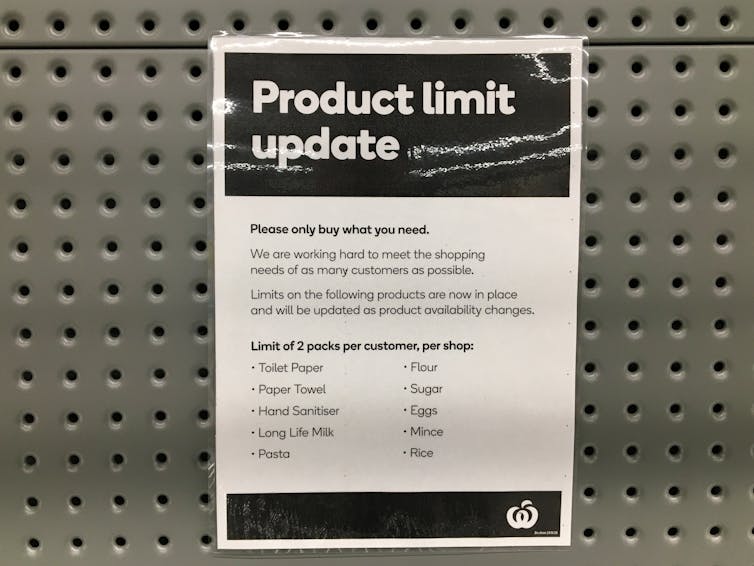 Signage for product limits in a Woolworths supermarket in Melbourne.
James Ross/AAP
Signage for product limits in a Woolworths supermarket in Melbourne.
James Ross/AAP
Well, one thing has not changed: there’s still a lag in supply chains responding to any sudden change in demand.
With toilet paper, for example, orders are generally fulfilled in about ten days. Last time it took about three weeks for more paper to make to it shops.
But, given the information of a spike in demand in Victoria made its way from shops and distributors to manufacturers almost instantly, things should happen faster this time.
Read more: Disagreeability, neuroticism and stress: what drives panic buying during the COVID-19 pandemic[2]
Retailers have already moved to answer the call by rerouting deliveries to increase supply where it is needed the most. The only thing stopping supply returning to normal is the speed of transportation and restocking.
Also, the spike in demand is heavily localised in Melbourne. While there have been reports of panic buying and stockpiling in other states, it’s nowhere near the level of a few months ago.
So shortages in Victoria will not be as prolonged as last time. Redirecting inventories will be a lot simpler.
Think of it this way. Panic buying during March was like a big detour in the supply-chain highway given the whole country was involved. Now it is more like a car with a flat tyre reducing traffic speed locally. It’s not less dramatic for the people affected, but much simpler from a supply-chain perspective.
Read more: A toilet paper run is like a bank run. The economic fixes are about the same[3]
The new normal
So don’t panic. There’s less reason to join in the panic buying (or stockpiling, if you think of it as a rational response to lockdown) this time. We’re likely to experience these disruptions so long as COVID-19 outbreaks continue. The “new normal” is like a faulty switch. Regions will be on and off the spot until the pandemic is over.
But as long as the entire nation does not move backwards all at the same time, supply chains from one state will quickly support the one experiencing difficulties.
There’s really no reason for you to add to the problem.
References
- ^ Stocking up to prepare for a crisis isn't 'panic buying'. It's actually a pretty rational choice (theconversation.com)
- ^ Disagreeability, neuroticism and stress: what drives panic buying during the COVID-19 pandemic (theconversation.com)
- ^ A toilet paper run is like a bank run. The economic fixes are about the same (theconversation.com)
Authors: Flavio Romero Macau, Senior Lecturer in Supply Chain Management and Global Logistics, Edith Cowan University