Yelp’s addition of a ‘Black-owned’ tag led to a slight drop in business ratings in Detroit
- Written by: Matthew Bui, Assistant Professor of Information and Digital Studies, University of Michigan
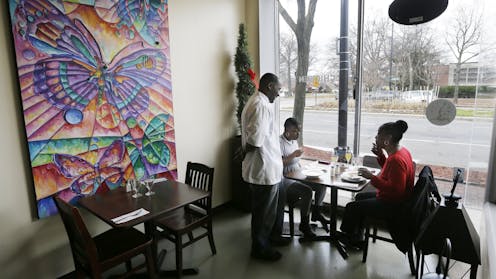
When the online review platform Yelp added a “Black-owned” tag in 2020, it boosted the visibility of Black-owned restaurants in Detroit[1]. It also caused their ratings to drop, according to our recent study[2].
Both local and nonlocal reviewers who showed awareness of a restaurant’s Black ownership rated restaurants 3.03 stars on average. Those who did not acknowledge Black ownership gave a rating of 3.78 stars on average. The tag seems to have caused the average rating to drop by attracting more reviewers who were aware of Black ownership.
Why it matters
Technology companies often introduce new features and tools[3] to influence user behavior and make their platforms more usable.
Although Yelp intended to support Black communities[4] with the Black-owned tag, the design intervention was harmful to Black restaurant owners in Detroit because Yelp failed to consider platform and community-based factors that significantly shape user interactions.
Yelp’s user base is predominantly white[5], educated and affluent[6]. Making Detroit’s Black-owned restaurants more visible to Yelp users may have amplified cross-cultural interactions and frictions. For example, non-Black users sometimes mentioned “slower” and “rude” service as justifications for lower ratings. Close readings of these reviews hinted at intercultural and communicative clashes.
And even businesses that don’t select the tag are identified within searches as Black-owned, based on user reviews and relevant links. Yelp doesn’t provide a way for the business to opt out of these search results.
How we did our work
To examine the local impacts of Yelp’s Black-owned tag, we collected over 250,000 Yelp reviews of Black- and non-Black-owned restaurants in Detroit and Los Angeles.
We identified Black-owned restaurants through community-sourced lists for Detroit[7] and Los Angeles[8] and then generated a random sample for the non-Black-owned restaurants.
We then identified reviews that explicitly noted “Black ownership” for closer analysis.
Detroit’s Black-owned businesses saw a greater loss in business[9] compared with “ownership-unreported” restaurants during the COVID-19 pandemic. This means they also potentially had more to gain from the new tag.
We found the awareness of Black ownership on Yelp significantly increased following Yelp’s addition of the Black-owned tag in June 2020. A year after the tag was added, reviews in Detroit mentioned Black ownership 4.3% more often than a year before it was rolled out.
Detroit Black-owned restaurants also saw a small temporary spike in their number of reviews, largely around the time Yelp added the Black-owned tag. At the same time, the restaurants’ average star ratings dropped from 3.91 to 3.88. In contrast, non-Black-owned restaurants’ ratings stayed relatively steady at 3.90.
This metric is an aggregate of all Detroit restaurants’ Yelp reviews over their entire existence, so a .03-star rating change is small but significant.
Even minor changes to star ratings affect the number of diners restaurants attract[10], their earning potential[11] and the likelihood they will sell out of food[12].
Adding obstacles in digital platforms serves to reproduce and amplify inequalities these businesses already face, rather than alleviate them. For example, Black-owned businesses have a harder time getting loans and are relatively underrepresented in Michigan[13] as a whole.
These findings may seem surprising given that Detroit is a majority Black city. However, Black users on Yelp are a minority. Keeping in mind the skewed user base of Yelp, we hypothesize the lower reviews for businesses featuring a Black-owned tag reflect existing racial and digital divides[14] in the city.
Generally, our study provides additional evidence that digital interventions are not “one-size-fits-all,” nor is digital visibility inherently positive[15] for all businesses.
The Research Brief[16] is a short take on interesting academic work.
References
- ^ Detroit (theconversation.com)
- ^ our recent study (doi.org)
- ^ new features and tools (carnegieendowment.org)
- ^ support Black communities (blog.yelp.com)
- ^ predominantly white (www.nber.org)
- ^ educated and affluent (www.yelp-press.com)
- ^ Detroit (docs.google.com)
- ^ Los Angeles (data.lacity.org)
- ^ greater loss in business (doi.org)
- ^ affect the number of diners restaurants attract (doi.org)
- ^ earning potential (dl.acm.org)
- ^ likelihood they will sell out of food (doi.org)
- ^ relatively underrepresented in Michigan (www.blackbizalliance.org)
- ^ digital divides (detroitcommunitytech.org)
- ^ inherently positive (doi.org)
- ^ Research Brief (theconversation.com)