Tip pressure might work in the moment, but customers are less likely to return
- Written by: Sara Hanson, Associate Professor of Marketing, University of Richmond
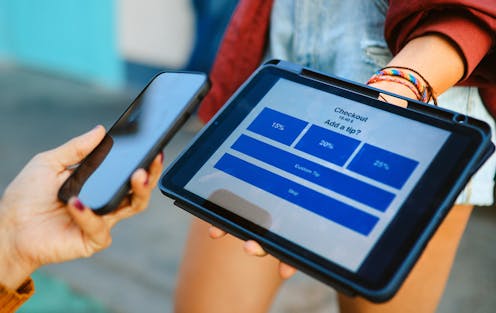
Have you ever hesitated at the register, uncomfortable as an employee watched you choose a tip? It’s not just you. The rise of digital tipping systems – from point-of-sale devices held by employees to countertop screens that clearly display your selection – is changing the dynamics of tipping, often in ways that make customers feel scrutinized.
As marketing[1] professors[2] who study digital tipping[3], we wanted to find out how customers respond to this sort of “tip surveillance.” So we conducted a field study analyzing 36,000 transactions and did four controlled experiments with more than 1,100 participants.
We compared tipping setups with less privacy – such as when firms use handheld payment systems, when employees are facing customers, and when apps immediately show tips to employees – with setups with more privacy, such as countertop payment systems, employees who face away from customers, and apps that disclose tips only after the service.
Our results were clear[4]: High levels of surveillance are bad for business. Customers who felt watched while tipping were less likely to make a return visit or recommend a business. While privacy often made customers feel more generous and in control of their decisions, feeling scrutinized led to resentment and reduced loyalty.
Interestingly, research shows that people enjoy being watched[5] when they donate to charity. So why does tipping feel different? Perhaps because tipping isn’t entirely voluntary – it’s often seen as an expectation. When customers feel pressured, they lose the sense of control that makes tipping a positive experience.
Welcome to the payment panopticon
While digital tipping can be convenient[6], it can also contribute to “tipflation” – the feeling that[7] tipping expectations have[8] gotten out of hand[9]. If companies want to make sure customers keep coming back, our research indicates they would do well to give customers privacy to tip.
One issue might be that some employees think watching customers closely encourages them to tip generously[10]. We didn’t find a straightforward relationship, however, between tipping privacy and tip amounts. While privacy empowers customers to tip less if they choose, we found it also often encourages them to feel more generous. These effects mean that customers tip similar amounts whether they have privacy or not.
For companies, striking the right balance between giving customers control and fostering generosity is crucial. A business that trains its employees to give customers privacy to tip – and makes sure to pay those employees fairly, so they don’t need to pressure customers in the first place – will likely develop a better reputation and a more loyal customer base.
The next horizons of tipping
Tipping can be a feel-good experience, enhancing feelings of generosity[11] and social status[12]. It can also be a source of anxiety[13]. And for better or worse, digital technology is changing the way we tip[14]. Today, people tip more money[15], for more services, and in more places[16] than ever before.
As businesses, customers and even politicians[17] debate how to best integrate digital tipping into our world, our research shows the importance of thinking holistically. In our view, the focus shouldn’t just be on boosting tipping revenue for employees[18] but also on creating a positive experience for customers[19].
More broadly, customers, workers, businesses and society may want to consider how to create a system of tipping that protects workers’ rights and dignity while guaranteeing fair pay, and that allows customers and business owners to reward employees who contribute[20] by providing great service.
References
- ^ marketing (robins.richmond.edu)
- ^ professors (www.bi.edu)
- ^ digital tipping (doi.org)
- ^ results were clear (doi.org)
- ^ enjoy being watched (doi.org)
- ^ can be convenient (doi.org)
- ^ the feeling that (www.wsj.com)
- ^ tipping expectations have (www.forbes.com)
- ^ gotten out of hand (doi.org)
- ^ encourages them to tip generously (doi.org)
- ^ feelings of generosity (doi.org)
- ^ social status (doi.org)
- ^ anxiety (www.marketwatch.com)
- ^ changing the way we tip (doi.org)
- ^ more money (doi.org)
- ^ in more places (doi.org)
- ^ even politicians (www.cnn.com)
- ^ boosting tipping revenue for employees (doi.org)
- ^ creating a positive experience for customers (doi.org)
- ^ who contribute (doi.org)